 ChipApex | Global Electronic Components Supplier
SEARCH
Search Product
Search Post
— IC芯片 | 连接器 | 传感器 | 被动器件 —
Search productSearch post
— IC芯片 | 连接器 | 传感器 | 被动器件 —
Consult the customer manager about the wholesale price.
consultation hotline:86-132-6715-2157
email:[email protected]
Contact the product manager for consultation. One-stop consultation is available.
Do you want a lower wholesale price? Please send us your inquiry and we will reply immediately.
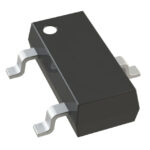
The PDTC114YT,215 is an NPN Resistor-Equipped Transistor (RET) manufactured by Nexperia USA Inc. in a SOT23 surface-mounted package. It integrates bias resistors with R1 = 10 kΩ and R2 = 47 kΩ to simplify circuit design. Key electrical parameters include a collector-emitter voltage (VCEO) of 50 V, an output current (IO) of 100 mA, and a total power dissipation (Ptot) of 250 mW at 25 °C. The device features a DC current gain (hFE) of 100 at IC = 5 mA and a transition frequency (fT) of 230 MHz. Limiting values specify a collector-base voltage (VCBO) of 50 V and an emitter-base voltage (VEBO) of 6 V.
Verify the specific ordering suffix matches the required packaging configuration. Confirm that the product status aligns with production requirements. Ensure compliance with RoHS directives as specified in the datasheet. Check for any recent Product Change Notifications (PCN) affecting assembly or materials. Validate that the non-automotive qualification meets the application's environmental standards.
Select this component when a compact NPN transistor with integrated base biasing is required. The SOT23 package is suitable for space-constrained surface-mount designs. Consider the 50 V rating and 100 mA current limit for appropriate load handling. Verify thermal performance against the derating curve if operating above 25 °C ambient temperature.
This part belongs to the Nexperia Resistor-Equipped Transistor (RET) family, designed to replace discrete resistor-transistor combinations. The PNP complement is the PDTA114YT. The product data sheet was revised on 25 April 2023, transitioning from a family document to a single-type specification and updating legal texts to reflect the Nexperia brand identity.
The PDTA114YT serves as the PNP complement within the same RET family. For direct pin-compatible substitution in similar circuits, verify the polarity requirements. Other RETs in the SOT23 package may be considered if different resistor ratios are needed, but ensure voltage and current ratings match the original design constraints.
 PDTC114YT,215
The activity of extra discounts on wholesale prices is in full swing…
Please fill in your contact information and we will send you the latest wholesale price list.






