 ChipApex | Global Electronic Components Supplier
SEARCH
Search Product
Search Post
— IC芯片 | 连接器 | 传感器 | 被动器件 —
Search productSearch post
— IC芯片 | 连接器 | 传感器 | 被动器件 —
Consult the customer manager about the wholesale price.
consultation hotline:86-132-6715-2157
email:[email protected]
Contact the product manager for consultation. One-stop consultation is available.
Do you want a lower wholesale price? Please send us your inquiry and we will reply immediately.
The PDTC123YK,115 is an NPN Resistor-Equipped Transistor (RET) from the PDTC123Y series, manufactured by Nexperia. It integrates a single NPN transistor with built-in bias resistors R1 and R2 in a SOT346 (SC-59A/TO-236) surface-mount package. The device features a collector-emitter voltage (VCEO) of 50 V and a continuous DC output current (IO) of 100 mA. The internal input bias resistor (R1) has a typical value of 2.2 kΩ, while the bias resistor ratio (R2/R1) is typically 4.5. Key electrical characteristics include a maximum collector-base cut-off current of 100 nA at VCB = 50 V and a DC current gain (hFE) minimum of 35 at IC = 5 mA.
Verify the ordering suffix '115' corresponds to the specific packing method defined in the official datasheet packing information table. Confirm that the SOT346 package variant matches the required footprint dimensions and pin configuration for the target PCB layout. Ensure compliance with the manufacturer's absolute maximum rating system limits during operation.
Select this component when a compact NPN solution with integrated base biasing is required for space-constrained designs. The SOT346 package offers a balance between thermal dissipation and small form factor compared to other RET variants. Verify that the 2.2 kΩ input resistance aligns with the driving source impedance requirements for the intended logic levels.
The PDTC123YK,115 belongs to the broader PDTC123Y family of NPN resistor-equipped transistors. This family includes various package options such as SOT23, SOT323, and SOT883, all sharing similar electrical characteristics but differing in physical dimensions and thermal properties. The 'Y' suffix denotes the specific resistor values (R1=2.2kΩ, R2=10kΩ), distinguishing it from other series members like PDTC123EU or PDTC143ZEF.
Direct functional substitutes within the same package include PDTC123YT (SOT23) if footprint adaptation is permitted, or PDTA123YK (PNP complement). Cross-package replacements require verifying pinout compatibility and thermal resistance differences.
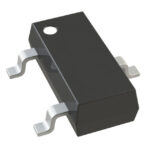 PDTC123YK,115
The activity of extra discounts on wholesale prices is in full swing…
Please fill in your contact information and we will send you the latest wholesale price list.





