 ChipApex | Global Electronic Components Supplier
SEARCH
Search Product
Search Post
— IC芯片 | 连接器 | 传感器 | 被动器件 —
Search productSearch post
— IC芯片 | 连接器 | 传感器 | 被动器件 —
Consult the customer manager about the wholesale price.
consultation hotline:86-132-6715-2157
email:[email protected]
Contact the product manager for consultation. One-stop consultation is available.
Do you want a lower wholesale price? Please send us your inquiry and we will reply immediately.
The PDTC124EU,115 is an NPN Resistor-Equipped Transistor (RET) manufactured by Nexperia USA Inc. It integrates bias resistors into a compact SOT-323 (SC-70) surface-mount package to simplify circuit design and reduce component count. The device features a collector-emitter voltage of 50 V and a continuous output current capability of 100 mA. Internal bias resistors are specified with a typical value of 22 kΩ for both R1 and R2, maintaining a ratio of 1. The transistor operates within an ambient temperature range of -65 °C to +150 °C and supports a junction temperature up to 150 °C.
Verify that the specific order suffix matches the required packaging format, as the base part number denotes the component while the suffix indicates reel or cut tape specifications. Confirm the absence of automotive qualification markings if the application requires standard commercial-grade components rather than AEC-Q101 certified parts. Ensure the ordering code aligns with the manufacturer's current production status.
Select this component when a single NPN transistor with integrated biasing is required for low-current digital switching. The 22 kΩ internal resistance values are suitable for standard logic interface applications. Consider the SOT-323 footprint constraints during layout planning. Verify that the 50 V collector-emitter rating meets the maximum voltage stress conditions of the target circuit environment.
This component belongs to the Nexperia PDTC124E series of resistor-equipped transistors. It serves as the NPN counterpart to the PDTA124EU PNP variant. The device represents a modern evolution of discrete bipolar transistors, consolidating multiple passive and active elements into a single surface-mount package to enhance assembly efficiency and reduce overall bill-of-materials complexity.
The PDTA124EU is the complementary PNP type within the same family. For equivalent NPN performance in different packages, consider the PDTC124ET variants housed in SOT-23. Standard BC847 series transistors may serve as functional replacements but require additional external biasing resistors.
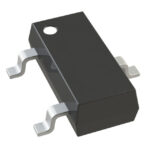 PDTC124EU,115
The activity of extra discounts on wholesale prices is in full swing…
Please fill in your contact information and we will send you the latest wholesale price list.






