 ChipApex | Global Electronic Components Supplier
SEARCH
Search Product
Search Post
— IC芯片 | 连接器 | 传感器 | 被动器件 —
Search productSearch post
— IC芯片 | 连接器 | 传感器 | 被动器件 —
Consult the customer manager about the wholesale price.
consultation hotline:86-132-6715-2157
email:[email protected]
Contact the product manager for consultation. One-stop consultation is available.
Do you want a lower wholesale price? Please send us your inquiry and we will reply immediately.
The PDTC144VT,215 is an NPN resistor-equipped transistor housed in a SOT23 surface-mount package. It integrates bias resistors to simplify circuit design and reduce component count. Key electrical parameters include a collector-emitter voltage (VCEO) of 50 V and a continuous DC output current (IO) of 100 mA. The internal input bias resistor (R1) has a typical value of 47 kΩ with a range of 33–61 kΩ. The bias resistor ratio (R2/R1) typically measures 0.21. The device operates within a junction temperature range up to 150 °C and features a thermal resistance from junction to ambient of 500 K/W in free air.
Verify the specific ordering suffix against official Nexperia documentation to confirm the exact packaging configuration and marking code. Confirm that the component status remains active for new designs by consulting the most recent product data sheet or availability lists from authorized distributors. Ensure compliance with RoHS directives as specified in the manufacturer's environmental declarations.
Select this component when an NPN digital transistor with a 47 kΩ input resistor and approximately 10 kΩ feedback resistor is required. Verify that the 50 V collector-emitter voltage rating meets the circuit's maximum operating conditions. Ensure the SOT23 package dimensions fit the available PCB footprint and that the 100 mA current capability satisfies the load requirements.
This part belongs to the PDTC144V series of NPN resistor-equipped transistors manufactured by Nexperia. It serves as the NPN counterpart to the PDTA144W series PNP devices. The series is designed for applications requiring integrated biasing to minimize board space and assembly complexity. The 'VT' designation specifically identifies the SOT23 package variant within this family.
The PDTA144VT is the complementary PNP device within the same series. Other packages in the PDTC144V series include PDTC144VE (SOT416), PDTC144VK (SOT346), PDTC144VM (SOT883), PDTC144VS (SOT54), and PDTC144VU (SOT323). Cross-package substitution requires verifying pinout compatibility and thermal performance differences.
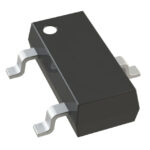 PDTC144VT,215
The activity of extra discounts on wholesale prices is in full swing…
Please fill in your contact information and we will send you the latest wholesale price list.





