ChipApex | Global Electronic Components Supplier
SEARCH
Search Product
Search Post
— IC芯片 | 连接器 | 传感器 | 被动器件 —
Search productSearch post
— IC芯片 | 连接器 | 传感器 | 被动器件 —
Consult the customer manager about the wholesale price.
consultation hotline:86-132-6715-2157
email:[email protected]
Contact the product manager for consultation. One-stop consultation is available.
Do you want a lower wholesale price? Please send us your inquiry and we will reply immediately.
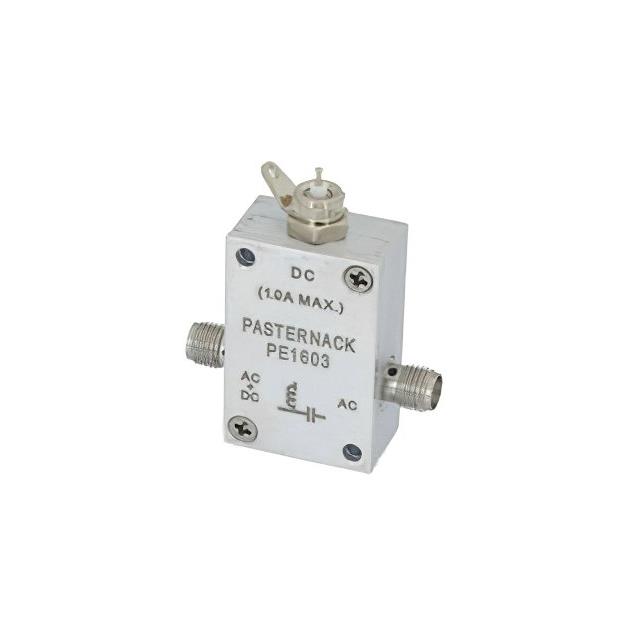
The PE1603 is a Pasternack bias tee designed for RF applications operating within a frequency range of 1 GHz to 5 GHz. It features an SMA female connector with a 50-ohm impedance interface. The component is rated to handle up to 1000 mA DC current and supports a maximum voltage of 50 Volts DC. This configuration allows for the simultaneous transmission of RF signals and DC power over a single coaxial line, ensuring signal integrity across the specified bandwidth while maintaining high isolation characteristics.
Verify part number authenticity through authorized Pasternack distributors or certified suppliers. Confirm datasheet version matches specific manufacturing lot requirements. Ensure storage conditions comply with ESD protection standards. Check for any updated technical revisions that may affect performance specifications prior to integration into final designs.
Select this component when a 50-ohm impedance match is required for frequencies between 1 and 5 GHz. Consider the 1000 mA current rating for active device biasing needs. Verify connector gender compatibility with existing SMA infrastructure. Evaluate isolation requirements against specific application noise floor constraints before implementation.
This bias tee belongs to Pasternack's series of RF signal conditioning components. It serves as a passive interconnect solution for combining DC power with RF signals. The design focuses on maintaining characteristic impedance stability while providing reliable DC injection capabilities for various microwave and RF subsystems requiring integrated power delivery.
Consult official Pasternack documentation for direct cross-reference part numbers. Verify electrical parameter equivalence including frequency range, current rating, and impedance. Ensure mechanical connector compatibility before substituting. Review manufacturer recommendations for alternative components with similar performance profiles.
The PE1603 is rated to handle a maximum DC current of 1000 mA.
Yes, it functions as a bias tee to combine RF signals and DC power on a single port.
The component operates effectively from 1 GHz to 5 GHz.
 PE1603
The activity of extra discounts on wholesale prices is in full swing…
Please fill in your contact information and we will send you the latest wholesale price list.