ChipApex | Global Electronic Components Supplier
SEARCH
Search Product
Search Post
— IC芯片 | 连接器 | 传感器 | 被动器件 —
Search productSearch post
— IC芯片 | 连接器 | 传感器 | 被动器件 —
Consult the customer manager about the wholesale price.
consultation hotline:86-132-6715-2157
email:[email protected]
Contact the product manager for consultation. One-stop consultation is available.
Do you want a lower wholesale price? Please send us your inquiry and we will reply immediately.
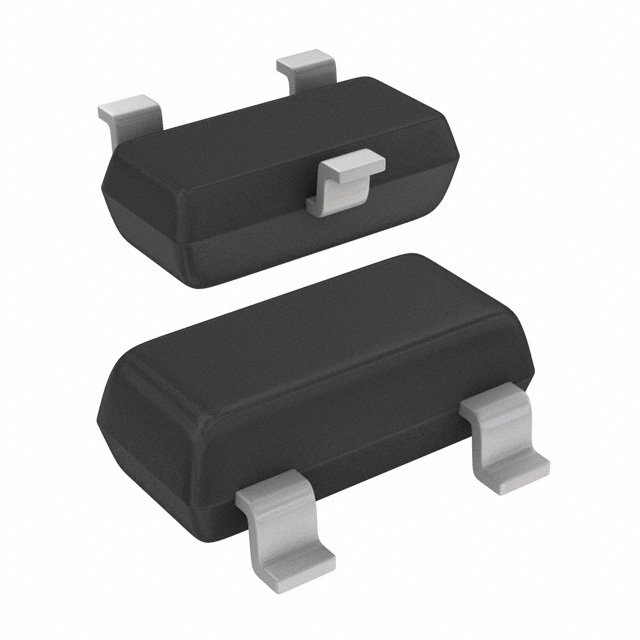
The PMBF4393,215 is an N-channel depletion-type junction field-effect transistor (JFET) manufactured by NXP Semiconductors. It is housed in a SOT-23 (TO-236AB) plastic microminiature surface-mount package with three leads. The device features symmetrical drain and source terminals that are interchangeable. Key electrical characteristics include a maximum drain-source voltage of 40 V, a maximum gate-source breakdown voltage of 40 V, and a feedback capacitance of less than 3.5 pF at 1 MHz. The on-resistance is specified at less than 100 Ω at 1 kHz.
Verify the component matches the April 1995 product specification document provided. Confirm the marking code corresponds to 'p6G' for the PMBF4393 variant. Ensure the package type is identified as SOT-23. Check for RoHS compliance status if required by specific design constraints, noting the original publication date may differ from current manufacturing standards.
Select this component when a symmetrical N-channel JFET is required for low-power switching or chopper applications. The interchangeable drain and source pins offer layout flexibility. Consider the 40 V voltage rating and low feedback capacitance for appropriate signal integrity in thin-film or thick-film environments.
The PMBF4393 belongs to a family of N-channel FETs produced by NXP Semiconductors, alongside variants such as the PMBF4391 and PMBF4392. These devices share similar structural characteristics but differ in specific electrical parameters like drain current and on-resistance thresholds. The PMBF4393 is distinguished by its specific resistance and current limits tailored for defined industrial switching loads.
Publicly confirmed substitute part numbers are not available in the provided documentation. Designers should consult official NXP channels for cross-reference data regarding equivalent components.
No, the drain and source terminals are symmetrical and interchangeable, allowing flexible circuit layout.
The maximum gate-source breakdown voltage is 40 V.
Yes, it has a feedback capacitance of less than 3.5 pF at 1 MHz, supporting relevant switching frequencies.
 PMBF4393,215
The activity of extra discounts on wholesale prices is in full swing…
Please fill in your contact information and we will send you the latest wholesale price list.