 ChipApex | Global Electronic Components Supplier

SEARCH
Search Product
Search Post
— IC芯片 | 连接器 | 传感器 | 被动器件 —
Search productSearch post
— IC芯片 | 连接器 | 传感器 | 被动器件 —
Consult the customer manager about the wholesale price.
consultation hotline:86-132-6715-2157
email:[email protected]
Contact the product manager for consultation. One-stop consultation is available.
Do you want a lower wholesale price? Please send us your inquiry and we will reply immediately.
The PTN3460IBS/F2Z is an Embedded DisplayPort to LVDS bridge IC designed for industrial and embedded applications. It converts DP streams from CPUs or GPUs into LVDS signals for display panels. The device supports link rates of 1.62 Gbit/s and 2.7 Gbit/s with one or two lanes. It handles pixel clocks from 6 MHz to 112 MHz, supporting 18 bpp and 24 bpp color depths in VESA or JEIDA formats. Powered by 3.3 V or dual supplies (3.3 V/1.8 V), it operates within a temperature range of -40 °C to +85 °C. The component is housed in a 7 mm x 7 mm HVQFN56 package.
Verify the specific firmware version indicated by the suffix 'F2' against system requirements, as versions are not necessarily backwards compatible. Confirm the operating environment falls within the specified -40 °C to +85 °C range. Ensure power supply configurations match the selected internal regulator or dual supply setup. Check that the HVQFN56 package dimensions fit the PCB layout constraints.
Select this component when interfacing eDP sources with legacy LVDS panels in harsh environments. Consider the F2 firmware revision if previous versions exhibited timing issues. Evaluate the need for EDID emulation if the target panel lacks storage. Verify compatibility with single or dual lane DP configurations based on bandwidth requirements.
This part belongs to the PTN3460I family of bridge controllers. The 'BS' indicates the reel packing method, while 'F2' specifies the firmware version programmed into the on-chip NVM. Other variants exist with different firmware revisions such as F1 or F6, which may offer updated features or bug fixes.
Public confirmed substitute part numbers are not available in the provided documentation. Firmware-specific variations like PTN3460IBS/F1 or PTN3460IBS/F6 serve as functional alternatives with different software profiles.
The 'F2' suffix denotes the specific firmware version programmed into the device's Non-Volatile Memory. Firmware versions are not necessarily backwards compatible.
Yes, the device supports EDID ROM emulation via configuration pin CFG4, allowing it to support panels that do not have an onboard EDID chip.
The DEV_CFG pin determines the I2C mode: pulling it low sets a low address (0x40h), leaving it open sets a high address (0xC0h), and pulling it high enables master mode for reading external EEPROMs.
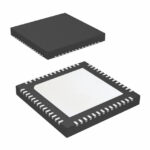 PTN3460IBS/F2Z

The activity of extra discounts on wholesale prices is in full swing…
Please fill in your contact information and we will send you the latest wholesale price list.





