ChipApex | Global Electronic Components Supplier
SEARCH
Search Product
Search Post
— IC芯片 | 连接器 | 传感器 | 被动器件 —
Search productSearch post
— IC芯片 | 连接器 | 传感器 | 被动器件 —
Consult the customer manager about the wholesale price.
consultation hotline:86-132-6715-2157
email:[email protected]
Contact the product manager for consultation. One-stop consultation is available.
Do you want a lower wholesale price? Please send us your inquiry and we will reply immediately.
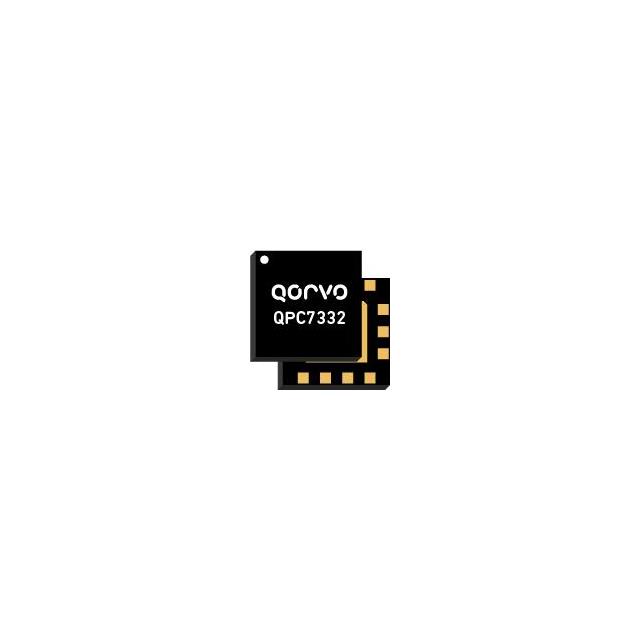
The QPC7332SR is a voltage-controlled variable cable slope equalizer manufactured by Qorvo, designed to compensate for frequency-dependent cable losses in broadband networks. Operating within a frequency range of 45 MHz to 1218 MHz, this component utilizes Silicon-On-Insulator (SOI) attenuator technology for precise signal adjustment. It functions with a standard 5 V supply voltage and draws a typical operating current of 2.7 mA. The device is housed in a compact 14-pin LQFN package with an exposed pad, measuring 6.0 mm, suitable for surface-mount assembly.
Verify the specific suffix 'SR' against the manufacturer's official documentation to confirm the exact reel packaging configuration and tape-and-reel specifications. Ensure that the 14-pin LQFN footprint matches the target PCB design guidelines. Confirm compliance with RoHS directives and check for any recent Product Change Notifications (PCN) that may affect material composition or manufacturing location prior to final procurement authorization.
Select the QPC7332SR when designing systems requiring active compensation for high-frequency attenuation over coaxial cables between 45 MHz and 1218 MHz. This component is appropriate for applications necessitating voltage-tunable gain profiles rather than fixed passive equalizers. Consider the 5 V single-supply operation and low current consumption when evaluating power budget constraints in dense electronic assemblies.
This component belongs to the QPC7332 series of variable equalizers from Qorvo. It is functionally related to other models such as the QPC7333, which covers a lower frequency range up to 684 MHz, and the QPC7336, which addresses similar frequencies but may differ in specific attenuation characteristics. The series represents Qorvo's solution for maintaining signal integrity in cable distribution environments.
Public confirmed substitute part numbers are not available in the provided documentation. Engineering teams should consult official Qorvo cross-reference guides or request direct manufacturer validation before considering alternative components to ensure impedance matching and performance consistency.
 QPC7332SR
The activity of extra discounts on wholesale prices is in full swing…
Please fill in your contact information and we will send you the latest wholesale price list.