ChipApex | Global Electronic Components Supplier
SEARCH
Search Product
Search Post
— IC芯片 | 连接器 | 传感器 | 被动器件 —
Search productSearch post
— IC芯片 | 连接器 | 传感器 | 被动器件 —
Consult the customer manager about the wholesale price.
consultation hotline:86-132-6715-2157
email:[email protected]
Contact the product manager for consultation. One-stop consultation is available.
Do you want a lower wholesale price? Please send us your inquiry and we will reply immediately.
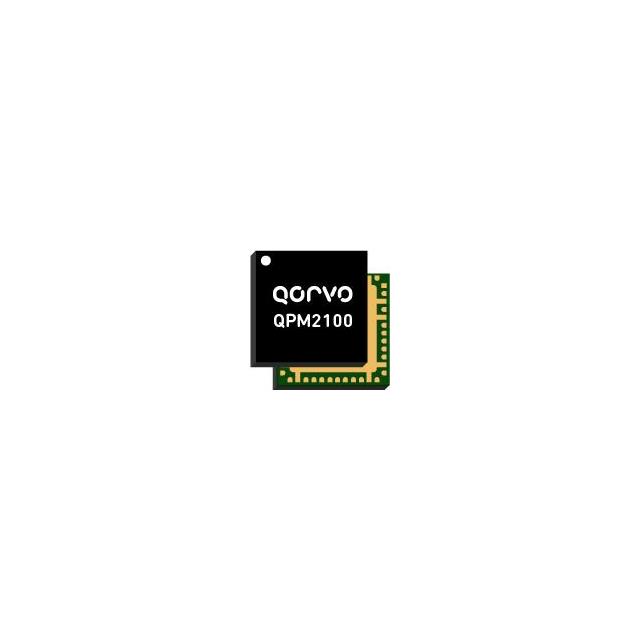
The QPM2100SR is a GaAs multi-chip transmit/receive module designed for S-band radar applications. It operates within the 2.5 GHz to 4.0 GHz frequency range and supports supply voltages from 2.5 V to 5 V. The device integrates a T/R switch, phase shifter, and driver amplifier into a single compact package. Key electrical specifications include an output power of 14.5 dBm and an operating temperature range spanning from -55°C to +95°C. The component is housed in a 48-QFN (7x7 mm) package, providing a robust solution for electronic warfare, communications, and radar systems requiring reliable RF performance.
Verify the specific suffix SR against official Qorvo documentation to confirm pinout compatibility and thermal characteristics. Ensure the procurement channel provides valid RoHS compliance certificates. Cross-reference the datasheet revision date with your design requirements to guarantee accurate parameter alignment. Confirm that the 48-QFN footprint matches your PCB layout constraints before finalizing orders.
Select this module when a compact, integrated solution for S-band radar is required. It combines multiple discrete components into one unit, reducing board space and complexity. Consider the 14.5 dBm output power and wide temperature tolerance for harsh environments. Verify that the 2.5V to 5V supply range aligns with your system's power architecture. This part is suitable for applications prioritizing integration over modular flexibility.
The QPM2100SR belongs to the QPM2100 series of multi-chip modules manufactured by Qorvo. This series targets S-band frequencies, offering a consolidated approach to RF front-end design. The SR variant specifies the particular packaging and configuration details. It serves as a critical component in modern radar and communication systems where size, weight, and power efficiency are paramount constraints.
Public confirmed substitute part numbers are not available in the provided documentation. Consult Qorvo directly for approved alternatives or obsolescence management strategies.
 QPM2100SR
The activity of extra discounts on wholesale prices is in full swing…
Please fill in your contact information and we will send you the latest wholesale price list.