 ChipApex | Global Electronic Components Supplier
SEARCH
Search Product
Search Post
— IC芯片 | 连接器 | 传感器 | 被动器件 —
Search productSearch post
— IC芯片 | 连接器 | 传感器 | 被动器件 —
Consult the customer manager about the wholesale price.
consultation hotline:86-132-6715-2157
email:[email protected]
Contact the product manager for consultation. One-stop consultation is available.
Do you want a lower wholesale price? Please send us your inquiry and we will reply immediately.
The RB715ZT2L is a Schottky barrier diode manufactured by ROHM Semiconductor, designed for surface mount applications. It features a dual anode common cathode configuration within a compact SOT-723 (VMD3) package. The device operates with a maximum repetitive reverse voltage of 40 V and supports an average rectified forward current of 30 mA. Key electrical characteristics include a maximum forward voltage of 0.37 V at 1 mA and a maximum reverse current of 1 uA at 10 V. It withstands a non-repetitive peak forward surge current of 200 mA and functions reliably up to a junction temperature of +125 °C.
Verify the specific ordering suffix to confirm the tape-and-reel packaging format intended for automated assembly processes. Confirm that the AEC-Q101 qualification status aligns with your system's automotive reliability requirements. Ensure the SOT-723 footprint matches your PCB design constraints before finalizing procurement orders.
Select this component when a dual-diode solution is required in a minimal footprint for low-current signal handling. The 40 V rating suits low-voltage logic interfaces, while the 30 mA current capacity limits its use to small-signal applications rather than power rectification. Consider thermal management capabilities if operating near the upper temperature limit.
This part belongs to ROHM's RB715 series of silicon Schottky barrier diodes. The series is characterized by low forward voltage and low reverse leakage current, making it suitable for general-purpose signal switching. The RB715Z variant specifically denotes the automotive-grade version housed in the VMD3 package, distinguishing it from standard commercial grades.
The RB715ZMT2L is documented as a recommended replacement with the same pinout and package type. Verify compatibility with existing board layouts when substituting this component.
The RB715ZT2L utilizes the SOT-723 package, also referred to as VMD3 or SC-105AA.
Yes, the RB715ZT2L is AEC-Q101 qualified, indicating suitability for automotive environments.
The maximum operating junction temperature is specified as +125 °C.
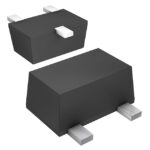 RB715ZT2L
The activity of extra discounts on wholesale prices is in full swing…
Please fill in your contact information and we will send you the latest wholesale price list.





