ChipApex | Global Electronic Components Supplier
SEARCH
Search Product
Search Post
— IC芯片 | 连接器 | 传感器 | 被动器件 —
Search productSearch post
— IC芯片 | 连接器 | 传感器 | 被动器件 —
Consult the customer manager about the wholesale price.
consultation hotline:86-132-6715-2157
email:[email protected]
Contact the product manager for consultation. One-stop consultation is available.
Do you want a lower wholesale price? Please send us your inquiry and we will reply immediately.
The RHRA1560CC is a hyperfast rectifier featuring silicon nitride passivated ion-implanted epitaxial planar construction. It provides a peak repetitive reverse voltage of 600 V and an average rectified forward current of 15 A at a case temperature of 140 °C. The device exhibits a maximum reverse recovery time of 35 ns under specified conditions, with a typical forward voltage drop of 2.1 V at 15 A. It supports a non-repetitive peak surge current of 200 A and operates within a junction temperature range of -65 to +175 °C.
Verify the manufacturer origin carefully, as Fairchild Semiconductor was acquired by onsemi. Confirm the specific revision status (Rev. A) and package marking (RHRA1560CCTU) against current supply chain documentation. Ensure compatibility with legacy designs originally specifying Fairchild components before finalizing procurement decisions.
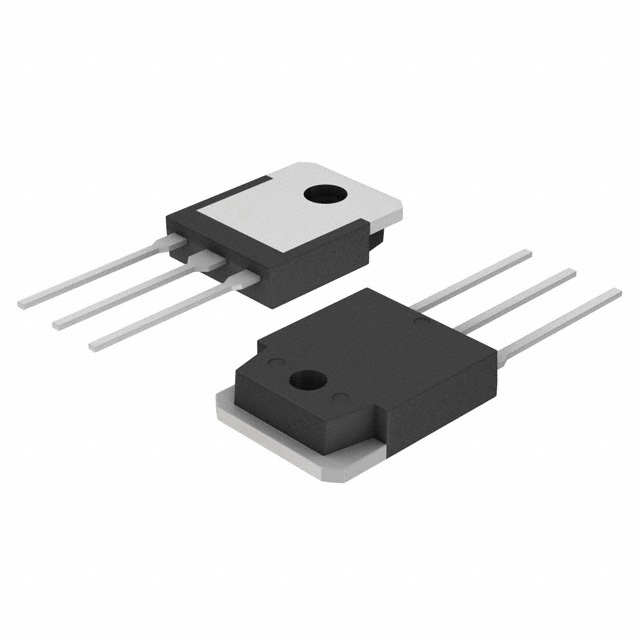
Select this component for applications requiring low stored charge and rapid recovery times below 35 ns. The TO-3PN package offers distinct thermal management capabilities compared to standard surface-mount options. Evaluate the avalanche energy rating if the circuit experiences significant transient inductive loads or switching spikes.
This device belongs to the hyperfast rectifier category, designed specifically for high-frequency power conversion tasks. It utilizes ion-implanted epitaxial planar technology to achieve superior switching speeds compared to standard ultrafast diodes. The dual-anode configuration allows for versatile circuit integration in bridge or half-bridge topologies.
Direct substitutes include the RHRG1560CC and ISL9R1560S3ST from onsemi. Verify pinout compatibility and thermal resistance specifications when transitioning between different package types such as TO-3PN, TO-247, or D2PAK.
The device is rated for 20 mJ of avalanche energy when tested with an inductance of 40 mH.
The reverse recovery time is specified as 35 ns at 1 A and increases to 40 ns at 15 A forward current under standard test conditions.
The maximum thermal resistance from junction to case is 1.5 °C/W.
 RHRA1560CC
The activity of extra discounts on wholesale prices is in full swing…
Please fill in your contact information and we will send you the latest wholesale price list.