ChipApex | Global Electronic Components Supplier
SEARCH
Search Product
Search Post
— IC芯片 | 连接器 | 传感器 | 被动器件 —
Search productSearch post
— IC芯片 | 连接器 | 传感器 | 被动器件 —
Consult the customer manager about the wholesale price.
consultation hotline:86-132-6715-2157
email:[email protected]
Contact the product manager for consultation. One-stop consultation is available.
Do you want a lower wholesale price? Please send us your inquiry and we will reply immediately.
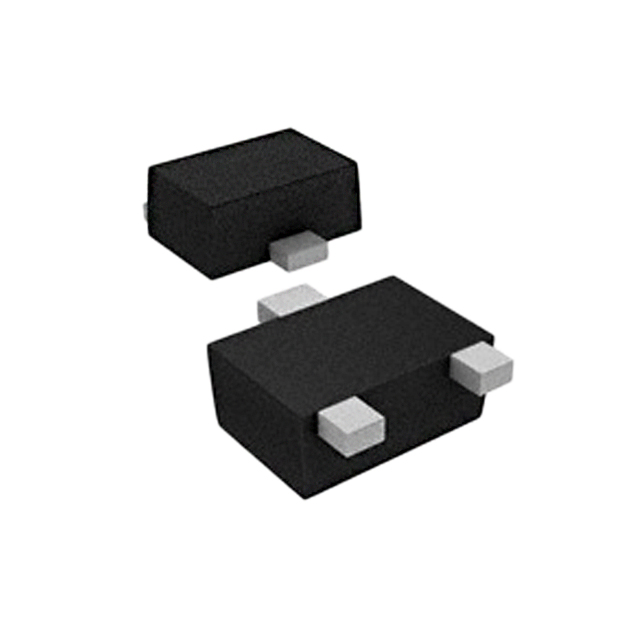
The RN1106MFV,L3F(CT is a single NPN Bias Resistor Built-in Transistor (BRT) manufactured by Toshiba Semiconductor and Storage. It integrates an NPN transistor with internal bias resistors in a compact SOT-723 (VESM) surface-mount package. Key electrical specifications include a collector-emitter breakdown voltage (VCEO) of 50 V, a continuous collector current (Ic) of 100 mA, and a maximum power dissipation (Pd) of 150 mW. The device features a typical base resistor (R1) of 4.7 kOhms and an emitter-base resistor (R2) of 47 kOhms. It has a minimum DC current gain (hFE) of 80 at Ic=10mA and Vce=5V. The component is qualified under AEC-Q101 standards for automotive applications.
Verify the specific suffix L3F(CT) against the manufacturer's official datasheet to confirm packaging details such as cut tape versus reel quantities. Ensure the procurement source provides valid traceability documentation for AEC-Q101 qualified components intended for automotive or high-reliability applications. Cross-reference the part number with Toshiba Semiconductor and Storage catalogs to avoid counterfeit components.
Select this component when a single NPN switch with integrated biasing is required for 50V logic interfaces. The 4.7k/47k resistor ratio suits standard TTL/CMOS driving levels. Consider the 150mW power dissipation limit and thermal characteristics of the SOT-723 package during layout. Verify that the 100mA collector current meets the load requirements without exceeding saturation voltage limits.
This part belongs to the RN11xx series of Bias Resistor Built-in Transistors from Toshiba. These devices are designed to replace discrete transistor-resistor networks, offering improved consistency and reduced assembly time. The RN1106 variant specifically provides a 4.7k base resistance, distinguishing it from other series members with different resistor ratios.
The RN1106MFV integrates a base resistor (R1) of 4.7 kOhms and an emitter-base resistor (R2) of 47 kOhms.
Yes, the component is qualified according to the AEC-Q101 standard, making it suitable for automotive electronic environments.
The maximum power dissipation (Pd) is specified as 150 mW.
 RN1106MFV,L3F(CT
The activity of extra discounts on wholesale prices is in full swing…
Please fill in your contact information and we will send you the latest wholesale price list.