 ChipApex | Global Electronic Components Supplier
SEARCH
Search Product
Search Post
— IC芯片 | 连接器 | 传感器 | 被动器件 —
Search productSearch post
— IC芯片 | 连接器 | 传感器 | 被动器件 —
Consult the customer manager about the wholesale price.
consultation hotline:86-132-6715-2157
email:[email protected]
Contact the product manager for consultation. One-stop consultation is available.
Do you want a lower wholesale price? Please send us your inquiry and we will reply immediately.
The RN2102,LF(CT is a PNP epitaxial planar silicon transistor manufactured by Toshiba Semiconductor and Storage. It integrates built-in bias resistors to simplify circuit design. The device features a maximum collector current of 100 mA and a collector-emitter voltage rating of 50 V. It operates within a temperature range up to 150 °C with a power dissipation of 150 mW. The component utilizes a small outline package with three pins, designed for surface mount applications in switching, inverter, interface, and driver circuits.
Verify the specific ordering suffix against official Toshiba documentation to confirm packaging type and tape/reel specifications. Ensure the part number matches the required RoHS compliance status and moisture sensitivity level for your assembly process. Cross-reference the manufacturer's latest datasheet to confirm pinout compatibility and thermal characteristics before finalizing procurement orders.
Select this component when a PNP digital transistor with integrated biasing is required for low-power switching applications. Consider the 50 V breakdown voltage and 100 mA current limits to ensure adequate headroom for the target load. Verify that the SOT-346 or equivalent small outline package fits the PCB footprint constraints and thermal management requirements of the design.
This part belongs to Toshiba's RN series of pre-biased transistors, which combine bipolar junction transistors with internal resistor networks. These devices are engineered to replace multiple discrete components, thereby saving board space and reducing assembly time. The RN2102 specifically addresses designs requiring PNP logic inversion or level shifting with minimal external circuitry.
Consult official cross-reference lists for direct substitutes. Potential alternatives include other PNP pre-biased transistors from manufacturers like Rohm or onsemi, provided they match the 50V/100mA ratings and pin configuration. Verify electrical parameters such as hFE and saturation voltage before substitution.
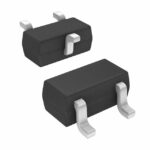 RN2102,LF(CT
The activity of extra discounts on wholesale prices is in full swing…
Please fill in your contact information and we will send you the latest wholesale price list.





