 ChipApex | Global Electronic Components Supplier
SEARCH
Search Product
Search Post
— IC芯片 | 连接器 | 传感器 | 被动器件 —
Search productSearch post
— IC芯片 | 连接器 | 传感器 | 被动器件 —
Consult the customer manager about the wholesale price.
consultation hotline:86-132-6715-2157
email:[email protected]
Contact the product manager for consultation. One-stop consultation is available.
Do you want a lower wholesale price? Please send us your inquiry and we will reply immediately.
The RN2410,LF is a PNP pre-biased bipolar junction transistor (BJT) manufactured by Toshiba Semiconductor and Storage. It features an integrated bias resistor network consisting of R1 (47 kOhms) and R2 (10 kOhms). Key electrical parameters include a maximum collector-emitter voltage of 50 V, a maximum collector current of 100 mA, and a transition frequency of 200 MHz. The device has a maximum power dissipation of 200 mW and a minimum DC current gain (hFE) of 50 at 10mA, 5V. It is housed in the S-Mini (TO-236-3/SC-59/SOT-23-3) surface-mount package.
Verify the specific suffix 'LF' indicates lead-free and RoHS compliance status as per manufacturer documentation. Confirm the package designation matches S-Mini or equivalent SC-59/SOT-23-3 footprints during PCB layout validation. Ensure that the internal resistor values (R1: 47k, R2: 10k) align with the target circuit's biasing requirements before finalizing component selection.
Select this component when a PNP transistor with fixed internal biasing is required to reduce board space and assembly complexity. The 50V rating and 100mA current capacity suit low-to-medium power switching tasks. Consider the 200MHz transition frequency for moderate-speed digital applications. Verify that the integrated resistor values meet the specific base drive needs of the application without requiring external discrete resistors.
The RN2410 belongs to Toshiba’s family of single, pre-biased bipolar transistors. These devices combine a BJT with internal resistors to replace multiple discrete components. This integration reduces circuit footprint and simplifies design processes. The RN2410 specifically utilizes a PNP configuration, making it suitable for high-side switching or logic interface applications where simplified biasing is advantageous over standard discrete transistors.
Public confirmed substitute part numbers are not provided in the available documentation. Consult official Toshiba Semiconductor and Storage resources for direct equivalents or pin-compatible alternatives.
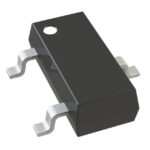 RN2410,LF
The activity of extra discounts on wholesale prices is in full swing…
Please fill in your contact information and we will send you the latest wholesale price list.





