 ChipApex | Global Electronic Components Supplier
SEARCH
Search Product
Search Post
— IC芯片 | 连接器 | 传感器 | 被动器件 —
Search productSearch post
— IC芯片 | 连接器 | 传感器 | 被动器件 —
Consult the customer manager about the wholesale price.
consultation hotline:86-132-6715-2157
email:[email protected]
Contact the product manager for consultation. One-stop consultation is available.
Do you want a lower wholesale price? Please send us your inquiry and we will reply immediately.
The SFH600-1 is a single-channel transistor output optocoupler featuring a gallium arsenide (GaAs) infrared LED emitter optically coupled to a silicon planar phototransistor detector with a base terminal. It provides high isolation capability of 5300 Vrms and operates within an ambient temperature range of -55°C to +100°C. The device supports a maximum forward current of 60 mA and offers a collector-emitter breakdown voltage of 70 V. The nominal current transfer ratio ranges from 63% to 125%, ensuring reliable signal transmission across industrial applications.
Verify the specific ordering suffix to confirm package type and tape/reel configuration, as standard DIP packaging may differ from bulk variants. Ensure compliance with RoHS directives and lead-free specifications required by your assembly process. Cross-reference the manufacturer datasheet for exact mechanical dimensions and soldering thermal profiles to guarantee compatibility with your PCB layout and reflow conditions.
Select this component when high isolation voltage and moderate speed are required for digital signal transmission. The presence of a base terminal on the phototransistor allows for improved linearity and faster switching compared to baseless configurations. Consider the 63-125% CTR range for biasing requirements and ensure the operating temperature range aligns with the environmental conditions of the target application.
The SFH600-1 belongs to Vishay's family of transistor output optocouplers designed for general-purpose isolation. It utilizes a 6-pin plastic dual in-line package (PDIP-6) suitable for through-hole mounting. This series is engineered to provide cost-effective isolation solutions while maintaining high reliability and safety standards for electronic circuits in demanding environments.
Direct substitutes include the SFH600-2 or SFH601-1X016, provided the current transfer ratio and isolation voltage ratings meet the design requirements. Verify pinout compatibility and package dimensions before substitution to ensure seamless integration into existing footprints without redesigning the printed circuit board.
The maximum collector-emitter breakdown voltage is specified as 70 V.
Yes, the device features a silicon planar phototransistor detector with a base terminal for enhanced control.
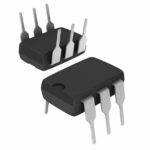 SFH600-1
The activity of extra discounts on wholesale prices is in full swing…
Please fill in your contact information and we will send you the latest wholesale price list.





