 ChipApex | Global Electronic Components Supplier

SEARCH
Search Product
Search Post
— IC芯片 | 连接器 | 传感器 | 被动器件 —
Search productSearch post
— IC芯片 | 连接器 | 传感器 | 被动器件 —
Consult the customer manager about the wholesale price.
consultation hotline:86-132-6715-2157
email:[email protected]
Contact the product manager for consultation. One-stop consultation is available.
Do you want a lower wholesale price? Please send us your inquiry and we will reply immediately.
The SG-8504CA-PRLZ is a pin-configurable standard crystal oscillator (XO) manufactured by EPSON. It operates within a frequency range of 50 MHz to 800 MHz and supports an LVPECL output format. The device functions on a supply voltage between 2.5V and 3.3V. It utilizes a base crystal resonator and is housed in an 8-SMD, no-lead package with dimensions of 7.00mm x 5.00mm. The component is designed for surface mount termination and supports operating temperatures down to -40°C.
Verify the specific ordering suffix against the official EPSON datasheet to ensure correct frequency and package configuration. Confirm that the LVPECL output format matches the target circuit requirements. Check for availability status as some variants may be obsolete. Ensure the 2.5V to 3.3V supply voltage aligns with the system power design. Validate the 8-SMD package footprint against the PCB layout specifications.
Select this component when a standard XO with configurable pins is required for frequencies between 50 MHz and 800 MHz. Consider the LVPECL output drive capability for impedance matching. Evaluate the thermal performance at minimum operating temperatures of -40°C. Compare the 7.00mm x 5.00mm package size against spatial constraints in the assembly design.
The SG-8504CA series represents EPSON's line of pin-configurable oscillators, offering flexibility in design-in processes. This model specifically uses a crystal base resonator for stability. It belongs to the standard clock oscillator category, distinct from VCXOs or TCXOs. The PRLZ suffix indicates a specific package and configuration variant within the broader SG-8504 family.
Direct substitutes are not explicitly confirmed in public documentation. Cross-reference with other SG-8504CA variants having identical pin configurations and electrical parameters. Verify compatibility with existing PCB footprints and signal integrity requirements before substitution.
The SG-8504CA-PRLZ provides an LVPECL (Low Voltage Positive Emitter Coupled Logic) output format.
The component supports a minimum operating temperature of -40°C, with specific maximum limits defined in the full datasheet.
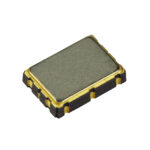 SG-8504CA-PRLZ

The activity of extra discounts on wholesale prices is in full swing…
Please fill in your contact information and we will send you the latest wholesale price list.





