 ChipApex | Global Electronic Components Supplier

SEARCH
Search Product
Search Post
— IC芯片 | 连接器 | 传感器 | 被动器件 —
Search productSearch post
— IC芯片 | 连接器 | 传感器 | 被动器件 —
Consult the customer manager about the wholesale price.
consultation hotline:86-132-6715-2157
email:[email protected]
Contact the product manager for consultation. One-stop consultation is available.
Do you want a lower wholesale price? Please send us your inquiry and we will reply immediately.
The SG-9101CA-C02SHBAC is a programmable spread spectrum crystal oscillator (XO) manufactured by EPSON. It features a CMOS output and supports a frequency range of 670 kHz to 20 MHz. The device operates on a supply voltage between 1.62V and 3.63V and includes a standby function for power management. It is housed in a compact 4-SMD, no-lead package with dimensions of 5.00mm x 3.20mm x 1.30mm maximum height. The unit is designed for surface mount installation and functions within an operating temperature range of -40°C to 105°C.
This component is supplied as a blank oscillator requiring specific frequency programming during the ordering process. Customers must input the desired frequency value in the order remarks when purchasing through authorized distributors such as DigiKey. Verification of the exact part number suffix is essential to ensure compatibility with the required voltage and package specifications before finalizing procurement orders.
Select this model when a custom frequency solution is required within the 670 kHz to 20 MHz range. Ensure the design accommodates the 1.62V to 3.63V supply voltage window. The 4-SMD no-lead package requires appropriate PCB footprint design for surface mounting. Verify that the application environment stays within the -40°C to 105°C operational temperature limits to maintain performance integrity.
The SG-9101CA series represents EPSON's line of programmable spread spectrum crystal oscillators. These devices offer flexibility compared to fixed-frequency alternatives by allowing customized clock speeds. The CA variant specifically denotes the standard XO type with CMOS output levels. This series is engineered for applications demanding reduced EMI through spread spectrum techniques while maintaining high frequency stability in small form factors.
Direct substitutes are not explicitly listed in the provided documentation. When replacing this component, verify that any alternative matches the 4-SMD no-lead package dimensions, the 1.62V-3.63V supply range, and the CMOS output interface. Ensure the replacement also supports the required frequency range and spread spectrum functionality if EMI reduction is critical to the design.
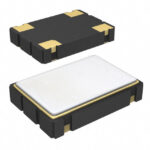 SG-9101CA-C02SHBAC

The activity of extra discounts on wholesale prices is in full swing…
Please fill in your contact information and we will send you the latest wholesale price list.





