 ChipApex | Global Electronic Components Supplier
SEARCH
Search Product
Search Post
— IC芯片 | 连接器 | 传感器 | 被动器件 —
Search productSearch post
— IC芯片 | 连接器 | 传感器 | 被动器件 —
Consult the customer manager about the wholesale price.
consultation hotline:86-132-6715-2157
email:[email protected]
Contact the product manager for consultation. One-stop consultation is available.
Do you want a lower wholesale price? Please send us your inquiry and we will reply immediately.
The SI2434-D-GTR is a global Data Access Arrangement (DAA) modem integrated circuit manufactured by Skyworks Solutions Inc. It operates within the ISOmodem series and supports data rates up to 33.6 kbps. The device complies with V.21, V.22, V.23, V.29, V.32, Bell 103, and Bell 212A standards. It functions on a supply voltage range of 3V to 3.6V and utilizes a 24-TSSOP package with a width of 4.40mm. The component is designed for surface mount installation and maintains a Moisture Sensitivity Level (MSL) of 3.
Verify the specific suffix against manufacturer documentation to confirm tape-and-reel packaging versus tube variants. Ensure compatibility with existing board layouts regarding the 24-TSSOP footprint dimensions. Confirm that the selected revision matches the required regulatory certifications for the target market. Cross-reference the datasheet version to validate pinout consistency before finalizing procurement orders.
Select this component when designing systems requiring support for older analog modem protocols alongside modern digital interfaces. Compare performance requirements against the SI2493 if higher speed V.34 or V.90 modulation is necessary. Evaluate power consumption constraints as the device operates within a specific voltage window. Consider the physical package size relative to available PCB space in compact embedded designs.
This part belongs to the Skyworks ISOmodem family, which provides complete modem solutions for telephone network interfaces. The SI2434 variant specifically targets lower-speed applications compared to the SI2493. It serves as a bridge between digital host processors and the public switched telephone network. The family shares common architectural features while differing in supported protocol speeds and regional DAA configurations.
The SI2434-D-GT serves as a direct tube-packaged alternative. For applications requiring faster data transmission, the SI2493 series offers backward compatibility with additional V.34 support. Verify pin-to-pin compatibility and software driver availability when substituting these components in existing designs.
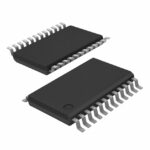 SI2434-D-GTR
The activity of extra discounts on wholesale prices is in full swing…
Please fill in your contact information and we will send you the latest wholesale price list.





