 ChipApex | Global Electronic Components Supplier
SEARCH
Search Product
Search Post
— IC芯片 | 连接器 | 传感器 | 被动器件 —
Search productSearch post
— IC芯片 | 连接器 | 传感器 | 被动器件 —
Consult the customer manager about the wholesale price.
consultation hotline:86-132-6715-2157
email:[email protected]
Contact the product manager for consultation. One-stop consultation is available.
Do you want a lower wholesale price? Please send us your inquiry and we will reply immediately.
The SMUN2233T1G is an NPN Bias Resistor Transistor (BRT) manufactured by onsemi, designed to replace discrete transistor and resistor networks. It integrates a single NPN silicon transistor with a monolithic bias network consisting of a series base resistor (R1) and a base-emitter resistor (R2). The device features a maximum collector current of 100 mA and a collector-emitter voltage rating of 50 V. It is housed in a compact SOT-323 (SC-70) surface-mount package with dimensions of 2.2 x 1.35 x 0.9 mm. The typical internal resistance ratio is 1:10, with R1 at 4.7 kΩ and R2 at 47 kΩ. It supports a maximum operating temperature of +150 °C and has a power dissipation of 310 mW.
Verify the specific suffix against official datasheets, as ordering codes may indicate variations in packaging or automotive qualification status. Confirm RoHS compliance and halogen-free status through manufacturer declarations. Ensure the selected variant matches the required bias resistor values and thermal performance specifications for the target application environment.
Select this component when space constraints require integrating bias resistors directly with the transistor. Compare the integrated R1 and R2 values against discrete designs to ensure proper base drive and leakage characteristics. Consider the SOT-323 package size for PCB layout optimization and verify thermal dissipation capabilities under maximum load conditions.
This part belongs to the MUNx233 family of digital transistors from onsemi, which are engineered to streamline the design of switching and amplification circuits. The BRT architecture consolidates multiple passive and active components into a single semiconductor die, enhancing reliability while minimizing footprint in consumer electronics and industrial control systems.
Equivalent parts include MMUN2233LT1G and MUN2233T1G within the same product family. Cross-reference with DTC143Zxx series devices from other manufacturers if pin compatibility and electrical parameters align. Verify that substitute components meet the same voltage, current, and thermal ratings.
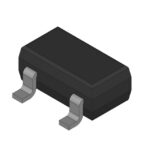 SMUN2233T1
The activity of extra discounts on wholesale prices is in full swing…
Please fill in your contact information and we will send you the latest wholesale price list.





