 ChipApex | Global Electronic Components Supplier
SEARCH
Search Product
Search Post
— IC芯片 | 连接器 | 传感器 | 被动器件 —
Search productSearch post
— IC芯片 | 连接器 | 传感器 | 被动器件 —
Consult the customer manager about the wholesale price.
consultation hotline:86-132-6715-2157
email:[email protected]
Contact the product manager for consultation. One-stop consultation is available.
Do you want a lower wholesale price? Please send us your inquiry and we will reply immediately.
The SN74AC14DRG4 is a hex Schmitt-trigger inverter manufactured by Texas Instruments. It operates within a supply voltage range of 2V to 6V and supports a maximum load capacitance of 50 pF. The device features six independent inverting channels with Schmitt-trigger inputs for noise filtering. It is housed in a 14-pin Small Outline Integrated Circuit (SOIC) package with a width of 3.90 mm. The component functions reliably across an operating temperature range from -40°C to +85°C.
Verify the specific ordering suffix DRG4 to confirm the tape-and-reel packaging format and lead-free composition. Ensure compatibility with standard SOIC-14 footprints during PCB layout. Confirm RoHS compliance status matches current regulatory requirements for the target market. Validate that the AC logic family specifications align with the system's voltage and speed requirements.
Select this component when high noise immunity is required for digital signal inversion. The Schmitt-trigger feature distinguishes it from standard inverters, making it suitable for interfaces with analog-like waveforms. Consider the AC series performance characteristics relative to other logic families if lower power consumption or different voltage ranges are prioritized over the specific switching speeds provided here.
This part belongs to the SN74AC series of advanced CMOS logic devices produced by Texas Instruments. The 'A' denotes the Advanced CMOS technology, while 'C' indicates the inclusion of Schmitt-trigger inputs. The suffix 'G4' specifies the green, lead-free, and RoHS-compliant manufacturing variant. It serves as a functional equivalent to other hex Schmitt-trigger inverters in the broader 74xx logic ecosystem.
The SN74AC14DR is a direct manufacturer-recommended alternative offering identical electrical characteristics without the G4 suffix. Other compatible options include the SN74ACT14DRG4 for faster switching speeds and the SN74HC14 variants for different drive capabilities. Verify pinout compatibility before substituting with non-TI equivalents.
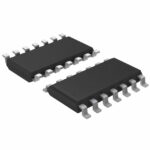 SN74AC14DRG4
The activity of extra discounts on wholesale prices is in full swing…
Please fill in your contact information and we will send you the latest wholesale price list.





