 ChipApex | Global Electronic Components Supplier
SEARCH
Search Product
Search Post
— IC芯片 | 连接器 | 传感器 | 被动器件 —
Search productSearch post
— IC芯片 | 连接器 | 传感器 | 被动器件 —
Consult the customer manager about the wholesale price.
consultation hotline:86-132-6715-2157
email:[email protected]
Contact the product manager for consultation. One-stop consultation is available.
Do you want a lower wholesale price? Please send us your inquiry and we will reply immediately.
The SN74AHCT00QDRQ1 is an automotive-grade quad two-input NAND gate manufactured by Texas Instruments. It belongs to the SN74AHCT-Q1 series, designed for high-speed digital applications requiring CMOS compatibility with TTL voltage levels. The device operates within a supply voltage range of 4.5 V to 5.5 V and supports a wide operating temperature range from -40°C to +125°C. It features low dynamic power consumption and offers 8 mA output drive capability in both high and low states. The component is qualified under AEC-Q100 standards and is available in a 14-pin SOIC surface-mount package.
Verify the complete part number including the suffix 'QDRQ1' to ensure correct automotive grade, package type, and tape-and-reel packaging configuration. Confirm that the design-in process accounts for the specific 14-pin SOIC footprint and pinout requirements. Ensure compliance with AEC-Q100 reliability targets for the intended automotive application zone. Check for any recent product change notifications regarding manufacturing site or material composition updates.
Select this component when a quad NAND gate is required in automotive designs needing 5V TTL compatibility. The AHCT series provides faster switching speeds compared to standard 74HC devices while maintaining lower power dissipation than older bipolar technologies. Consider the 14-pin SOIC package constraints for PCB layout density. Verify that the 4.5V to 5.5V supply voltage aligns with the system's power rail specifications.
This part is part of Texas Instruments' SN74AHCT-Q1 family of automotive-qualified logic ICs. The family includes various logic functions such as inverters, buffers, and flip-flops, all sharing similar electrical characteristics and automotive reliability standards. The 'AHCT' designation indicates advanced high-speed CMOS technology with TTL-compatible inputs, distinguishing it from the standard AHC series which has CMOS-compatible inputs.
SN74AHCT00QPWRQ1: Same logical function and electrical specifications but housed in a TSSOP-14 package instead of SOIC-14. Requires PCB footprint modification.
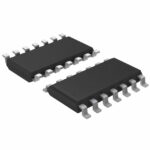 SN74AHCT00QDRQ1
The activity of extra discounts on wholesale prices is in full swing…
Please fill in your contact information and we will send you the latest wholesale price list.





