 ChipApex | Global Electronic Components Supplier
SEARCH
Search Product
Search Post
— IC芯片 | 连接器 | 传感器 | 被动器件 —
Search productSearch post
— IC芯片 | 连接器 | 传感器 | 被动器件 —
Consult the customer manager about the wholesale price.
consultation hotline:86-132-6715-2157
email:[email protected]
Contact the product manager for consultation. One-stop consultation is available.
Do you want a lower wholesale price? Please send us your inquiry and we will reply immediately.
The SN74AHCT373DW is an octal transparent D-type latch with three-state outputs manufactured by Texas Instruments. It operates within a supply voltage range of 4.5V to 5.5V and features TTL-compatible inputs. The device provides balanced CMOS outputs capable of sourcing and sinking up to 8mA. Propagation delay is specified at 9.5ns maximum at 5V VCC with a 15pF load. It utilizes a 20-pin SOIC package.
Verify the specific ordering suffix 'DW' corresponds to the SOIC-20 package configuration required for your design. Confirm that the component meets RoHS compliance standards if applicable to your manufacturing process. Ensure the datasheet version matches the revision date to validate all electrical characteristics and timing parameters before finalizing procurement specifications.
Select this component when a system requires an octal latch with three-state capability and TTL input compatibility. It is suitable for designs operating strictly within the 4.5V to 5.5V supply range. Consider the SOIC-20 package dimensions and thermal resistance values during PCB layout planning to ensure adequate heat dissipation and trace routing space.
This part belongs to the SNx4AHCT373 family of octal transparent D-type latches. The 'HCT' designation indicates High-speed CMOS technology with TTL-compatible input levels. The 'SN74' prefix denotes commercial grade temperature operation, while the 'DW' suffix specifies the surface-mount SOIC package type offered by Texas Instruments.
Direct substitutes include other SN74AHCT373 variants in different packages such as TSSOP (PW), SSOP (DB), or PDIP (N). Cross-family replacements like SN74HC373 or SN74HCT373 may be considered but require verification of speed and drive current differences against application requirements.
The Latch Enable (LE) pin controls data transparency; when high, data passes from D to Q. When low, the previous state is held. The Output Enable (OE) pin, active low, controls whether the outputs are driven or placed in a high-impedance state.
Unused inputs must not be left floating. They should be terminated to either VCC or GND to prevent excessive power consumption and oscillations caused by slow transitions or noise.
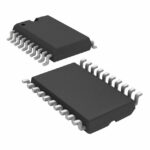 SN74AHCT373DW
The activity of extra discounts on wholesale prices is in full swing…
Please fill in your contact information and we will send you the latest wholesale price list.





