 ChipApex | Global Electronic Components Supplier
SEARCH
Search Product
Search Post
— IC芯片 | 连接器 | 传感器 | 被动器件 —
Search productSearch post
— IC芯片 | 连接器 | 传感器 | 被动器件 —
Consult the customer manager about the wholesale price.
consultation hotline:86-132-6715-2157
email:[email protected]
Contact the product manager for consultation. One-stop consultation is available.
Do you want a lower wholesale price? Please send us your inquiry and we will reply immediately.
The SN74ALVC14DG4 is a hex Schmitt-trigger inverter manufactured by Texas Instruments. It operates within a supply voltage range of 2.3V to 3.6V and features low static current consumption of 10 µA maximum. The device provides symmetric output drive currents of 24mA at both high and low states. Propagation delay is specified as 3.4ns at 3.3V with a 50pF load. It supports logic levels from 0.35V to 0.8V for low and 1.7V to 2V for high. The component is housed in a 14-SOIC package and functions reliably across an operating temperature range of -40°C to 85°C.
Verify the specific ordering suffix against the manufacturer's official documentation to confirm pinout, package dimensions, and electrical characteristics. Ensure the requested variant matches the required RoHS compliance status and moisture sensitivity level. Cross-reference the full part number with the latest datasheet revision to avoid discrepancies in performance parameters or packaging options.
Select this component when designing circuits that require precise noise rejection through Schmitt-trigger action within the ALVC voltage domain. The 14-SOIC package is suitable for surface-mount assembly processes. Consider the 3.4ns propagation delay and 24mA drive strength when evaluating timing constraints and load requirements in high-speed digital interfaces.
This device belongs to the Texas Instruments SN74ALVC14 family of hex Schmitt-trigger inverters. It is designed for use in low-voltage CMOS applications where noise immunity and fast switching speeds are critical. The ALVC series offers improved performance over standard LVC devices in terms of speed and power consumption while maintaining compatibility with 3.3V logic systems.
SN74ALVC14D
The device incorporates Schmitt-trigger inputs which provide distinct positive and negative threshold voltages, ensuring clean transitions even with slowly changing input signals.
No, the SN74ALVC14DG4 is rated for a supply voltage range of 2.3V to 3.6V and does not support 5V operation.
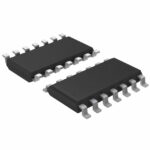 SN74ALVC14DG4
The activity of extra discounts on wholesale prices is in full swing…
Please fill in your contact information and we will send you the latest wholesale price list.





