 ChipApex | Global Electronic Components Supplier
SEARCH
Search Product
Search Post
— IC芯片 | 连接器 | 传感器 | 被动器件 —
Search productSearch post
— IC芯片 | 连接器 | 传感器 | 被动器件 —
Consult the customer manager about the wholesale price.
consultation hotline:86-132-6715-2157
email:[email protected]
Contact the product manager for consultation. One-stop consultation is available.
Do you want a lower wholesale price? Please send us your inquiry and we will reply immediately.
The SN74LS247NG4 is a BCD-to-7-segment decoder and driver manufactured by Texas Instruments. It belongs to the LS logic family and features open-collector outputs designed for direct LED drive applications. The device accepts 4-bit binary-coded decimal inputs and decodes them into seven active-low segment outputs. It includes an active-low lamp test input, an active-low blanking input, and an active-low ripple blanking input/output for multi-digit expansion. The component operates within a supply voltage range of 4.75 V to 5.25 V and is housed in a 16-pin PDIP package.
Verify the suffix 'G4' indicates RoHS compliance and green manufacturing status as per Texas Instruments documentation. Confirm the package type matches the required 16-pin DIP footprint. Ensure the design accounts for the open-collector output structure when interfacing with power supplies. Cross-reference the specific datasheet revision for timing parameters relevant to the application speed.
Select this component when a dedicated BCD-to-7-segment decoder with high-current drive capability is required. The open-collector architecture allows flexibility in pull-up voltage selection relative to the logic supply. Consider the propagation delay characteristics if operating at higher frequencies. Verify that the load capacitance requirements of the connected display segments fall within the specified limits for reliable switching.
This part is a variant of the SN74LS247 series, distinguished by the 'G4' suffix which denotes environmental compliance. It serves as a standard interface between digital logic circuits and visual numeric indicators. The LS family provides a balance of speed and power consumption suitable for general-purpose digital systems. It replaces earlier non-compliant versions while maintaining pin compatibility.
SN74LS247N
The active-low Lamp Test input forces all segment outputs high, illuminating all segments simultaneously to verify display functionality.
The Ripple Blanking Input/Output allows cascading multiple decoders to suppress leading or trailing zeros in multi-digit displays automatically.
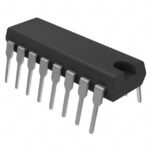 SN74LS247NG4
The activity of extra discounts on wholesale prices is in full swing…
Please fill in your contact information and we will send you the latest wholesale price list.





