ChipApex | Global Electronic Components Supplier
SEARCH
Search Product
Search Post
— IC芯片 | 连接器 | 传感器 | 被动器件 —
Search productSearch post
— IC芯片 | 连接器 | 传感器 | 被动器件 —
Consult the customer manager about the wholesale price.
consultation hotline:86-132-6715-2157
email:[email protected]
Contact the product manager for consultation. One-stop consultation is available.
Do you want a lower wholesale price? Please send us your inquiry and we will reply immediately.
The SSM2519 is a digital input, Class-D power amplifier integrating a DAC and sigma-delta modulator. It delivers 2.31 W into 4 Ω and 1.35 W into 8 Ω at 5 V supply with 1% THD+N. Efficiency reaches 90% at full scale into 8 Ω. The device operates on a 2.5 V to 5.5 V PVDD supply and a 1.5 V to 3.6 V VDD supply. It supports sample rates from 8.0 kHz to 48.0 kHz with an SNR of 98 dB (A-weighted) and PSRR of 80 dB at 217 Hz. Idle power consumption is 9 mW at 1.8 V/3.6 V.
Verify the specific ordering suffix matches the required package and reel specifications. Confirm that the component meets all relevant environmental compliance standards required for your target market. Ensure that the voltage levels on the MCLK, BCLK, and SDATA pins are compatible with your system's logic levels before integration.
Select this component for applications requiring a fully digital audio interface to minimize noise susceptibility from GSM interference or other digital signals. It is suitable for power-sensitive designs where high efficiency and low quiescent current are critical. Consider the available analog gain settings optimized for different PVDD voltages when designing the power supply rails.
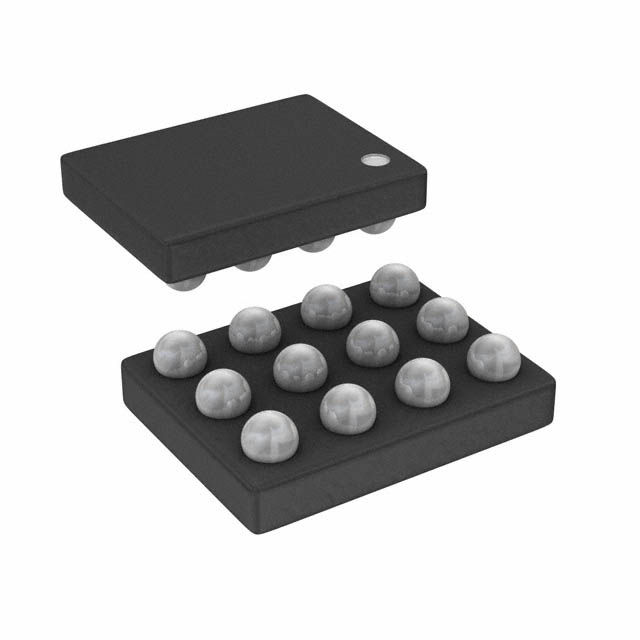
The SSM2519 is part of Analog Devices' portfolio of digital input Class-D audio amplifiers. It utilizes a three-level sigma-delta modulator designed to provide low EMI interference and high audio efficiency. The device is specified over the industrial temperature range of -40°C to +85°C and is housed in a compact 12-ball WLCSP package.
Public confirmed substitute part numbers are not available in the provided documentation.
Yes, the SSM2519 can operate without an external BCLK. If the BCLK pin is tied to ground or VDD, the device internally generates the appropriate bit clock rate based on the selected configuration.
The SD pin determines the operational mode. Tying it to VDD through a 20 kΩ resistor enables I2C control mode. Connecting it directly to VDD enables standalone mode. Pulling it low places the device in shutdown mode.
When enabled, the device analyzes the incoming digital audio. If zero samples are detected for 512 consecutive samples, the IC enters a low power state. It resumes normal operation upon receiving a single nonzero input sample.
 SSM2519ACBZ-R7
The activity of extra discounts on wholesale prices is in full swing…
Please fill in your contact information and we will send you the latest wholesale price list.