 ChipApex | Global Electronic Components Supplier
SEARCH
Search Product
Search Post
— IC芯片 | 连接器 | 传感器 | 被动器件 —
Search productSearch post
— IC芯片 | 连接器 | 传感器 | 被动器件 —
Consult the customer manager about the wholesale price.
consultation hotline:86-132-6715-2157
email:[email protected]
Contact the product manager for consultation. One-stop consultation is available.
Do you want a lower wholesale price? Please send us your inquiry and we will reply immediately.
The STA50813TR is a monolithic quad half-bridge stage audio amplifier manufactured by STMicroelectronics using Multipower BCD Technology. It operates with a supply voltage range of 10 V to 36 V and delivers an output power of 160 W into an 8-ohm load at THD = 10% when configured as a single bridge (BTL) with VCC at 35 V. The device features a 200 mΩ complementary DMOS output stage and supports dual bridge, single bridge with double current, or half-bridge configurations via the CONFIG pin. It includes under-voltage protection, thermal warning output, and thermal protection.
Verify the specific suffix 'TR' indicates tape-and-reel packaging configuration against the official datasheet revision. Confirm that the operating temperature range of -40°C to +90°C aligns with your system's environmental requirements. Ensure the 36 V maximum supply voltage rating is not exceeded in your power design. Check for RoHS compliance status as documented in the product specifications.
Select this component when a reconfigurable quad half-bridge stage is required for Class-D audio applications. It is suitable for designs needing flexibility between stereo and mono bridged configurations. Consider the 200 mΩ Rds(on) for efficiency calculations. Verify compatibility with CMOS logic inputs and threshold levels proportional to VL pin voltage for proper signal interfacing.
The STA50813TR belongs to the STA508 series of audio amplifiers from STMicroelectronics. This series utilizes Multipower BCD technology to integrate high-voltage DMOS outputs with control logic on a single chip. The device is designed for high-efficiency digital audio amplification, offering configurable output stages to meet varying power and channel requirements in professional and consumer audio systems.
Consult the official STMicroelectronics documentation for direct pin-to-pin replacements within the STA508 family. Verify electrical parameters such as supply voltage range, output current capability, and package dimensions before substitution. Ensure thermal management solutions are compatible with the replacement device's power dissipation characteristics.
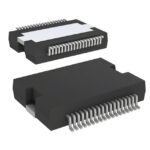 STA50813TR
The activity of extra discounts on wholesale prices is in full swing…
Please fill in your contact information and we will send you the latest wholesale price list.





