 ChipApex | Global Electronic Components Supplier
SEARCH
Search Product
Search Post
— IC芯片 | 连接器 | 传感器 | 被动器件 —
Search productSearch post
— IC芯片 | 连接器 | 传感器 | 被动器件 —
Consult the customer manager about the wholesale price.
consultation hotline:86-132-6715-2157
email:[email protected]
Contact the product manager for consultation. One-stop consultation is available.
Do you want a lower wholesale price? Please send us your inquiry and we will reply immediately.
The STISO621TR is a dual-channel digital isolator from STMicroelectronics, utilizing thick oxide galvanic isolation technology. It features two independent channels with 1-to-1 directionality and Schmitt trigger inputs for high noise immunity. The device supports data rates up to 100 Mbps with a maximum propagation delay of 42 ns and pulse width distortion under 3 ns. It operates on a supply voltage of 3V to 5.5V and withstands an isolation voltage of 4000 Vpk. Common-mode transient immunity is rated at 50 kV/µs. The component functions within a temperature range of -40°C to 125°C and is housed in an 8-SOIC package.
Verify the specific ordering suffix to confirm packaging type, such as tape-and-reel or cut tape, as these affect handling but not electrical function. Ensure compatibility with the target PCB footprint, specifically the 8-SOIC package dimensions. Confirm that the required isolation voltage rating meets the safety standards of the end application. Check for RoHS compliance status if environmental regulations apply to the manufacturing process.
Select this component when high-speed digital communication requires reliable galvanic isolation between circuits. The 100 Mbps data rate suits applications needing faster response than optical isolators. Consider the 8-SOIC package for space-constrained designs. Evaluate the 50 kV/µs CMTI rating against the noise environment of the power stage. Ensure the 3V to 5.5V supply range matches the logic levels of both sides of the isolation barrier.
The STISO621TR belongs to the STISO series of digital isolators based on ST's proprietary thick oxide technology. This family offers alternatives to traditional optocouplers by providing higher reliability and lower power consumption. The series includes single and dual-channel variants designed for various isolation requirements in industrial and consumer electronics.
Direct substitutes include other dual-channel digital isolators with similar 100 Mbps speeds and SO-8 packages. Verify pinout compatibility before swapping. Compare isolation voltage ratings and CMTI specifications to ensure equivalent performance in the specific circuit environment.
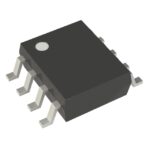 STISO621TR
The activity of extra discounts on wholesale prices is in full swing…
Please fill in your contact information and we will send you the latest wholesale price list.





