ChipApex | Global Electronic Components Supplier
SEARCH
Search Product
Search Post
— IC芯片 | 连接器 | 传感器 | 被动器件 —
Search productSearch post
— IC芯片 | 连接器 | 传感器 | 被动器件 —
Consult the customer manager about the wholesale price.
consultation hotline:86-132-6715-2157
email:[email protected]
Contact the product manager for consultation. One-stop consultation is available.
Do you want a lower wholesale price? Please send us your inquiry and we will reply immediately.
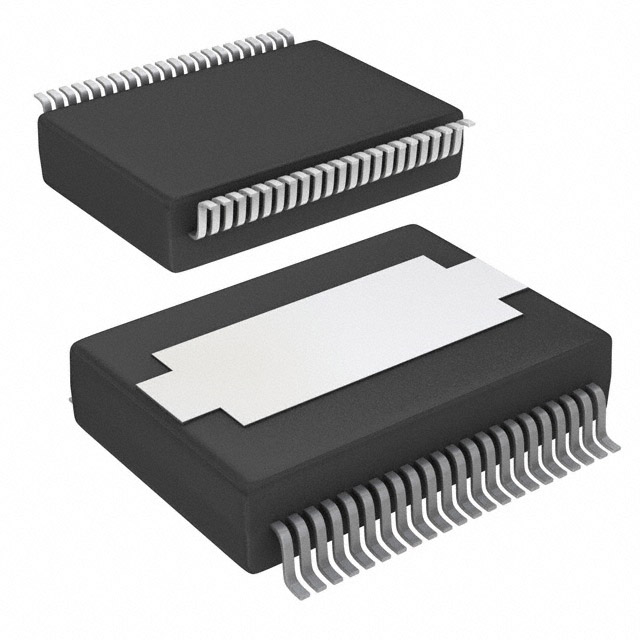
The TAS5424BTDKERQ1 is a four-channel automotive digital audio amplifier from Texas Instruments, designed for head units and external modules. It utilizes advanced Class-D technology to deliver high efficiency with reduced heat generation. The device features differential inputs to enhance noise immunity. It supports multiple power supply voltages, providing up to 38W per channel into a 2-ohm load at 14.4V, and up to 79W per channel into a 4-ohm load at 24V. In bridge-tied-load (PBTL) configuration at 24V, it delivers 150W into a 2-ohm load. Key performance metrics include a total harmonic distortion plus noise of less than 0.02% at 1kHz/1W into 4 ohms, a power supply rejection ratio of 75dB, and an output noise voltage of 60μV.
Verify the specific suffix TDKE against official Texas Instruments documentation to confirm package type and tape-and-reel specifications. Ensure the Q1 designation aligns with required AEC-Q100 automotive qualification standards for your target application environment. Cross-reference the datasheet revision date to ensure compatibility with current design guidelines.
Select this model when differential signaling is required to mitigate system noise in electrically noisy automotive environments. Choose the TAS5424B-Q1 variant over the TAS5414B-Q1 if input signal integrity is a primary concern. Consider the PBTL capability for applications requiring higher power output into lower impedance loads without increasing channel count.
This component belongs to the TAS54xxB-Q1 family of four-channel digital audio amplifiers. It shares core Class-D architecture and protection features with siblings like the TAS5414B-Q1, differing primarily in input configuration. The family targets modern vehicle infotainment systems demanding high fidelity within strict thermal and space constraints.
The TAS5414B-Q1 serves as a functional alternative but utilizes single-ended inputs rather than differential. Verify that the input stage of the host processor supports the required interface type before substituting. No other direct pin-to-pin replacements are documented in public sources.
 TAS5424BTDKERQ1
The activity of extra discounts on wholesale prices is in full swing…
Please fill in your contact information and we will send you the latest wholesale price list.