 ChipApex | Global Electronic Components Supplier
SEARCH
Search Product
Search Post
— IC芯片 | 连接器 | 传感器 | 被动器件 —
Search productSearch post
— IC芯片 | 连接器 | 传感器 | 被动器件 —
Consult the customer manager about the wholesale price.
consultation hotline:86-132-6715-2157
email:[email protected]
Contact the product manager for consultation. One-stop consultation is available.
Do you want a lower wholesale price? Please send us your inquiry and we will reply immediately.
The TAS5431-Q1 is a mono Class-D automotive audio amplifier featuring integrated load dump and I2C diagnostics. It delivers up to 8 W into a 4-ohm load at 10% THD+N from a 14.4-V supply, with an operating voltage range of 4.5 V to 18 V. The device achieves 83% efficiency and includes Speaker Guard protection. Key electrical parameters include a 75-dB PSRR, 63-dB CMRR, and 0.05% THD+N at 1 W output. It operates within a temperature range of -40°C to 125°C and utilizes a thermally enhanced 16-pin HTSSOP package.
Verify the specific ordering suffix matches the required package variant and tape-and-reel quantity. Confirm AEC-Q100 Grade 1 qualification aligns with target automotive reliability standards. Ensure design accounts for the 16-pin HTSSOP thermal pad soldering requirements to maintain specified junction-to-ambient thermal resistance values during operation.
Select this component for applications requiring high-efficiency mono amplification in space-constrained automotive environments. The differential analog input stage effectively rejects common-mode noise. Consider the adjustable gain settings and switching frequency options to optimize performance against AM radio interference while maintaining low distortion metrics.
This device belongs to Texas Instruments' automotive-grade digital audio amplifier portfolio designed for harsh electrical environments. It integrates advanced Class-D technology to reduce heat dissipation and peak currents compared to traditional linear amplifiers. The inclusion of onboard diagnostics reduces the need for external monitoring circuitry, simplifying system architecture.
No direct public substitute part numbers are confirmed in the provided documentation.
The device runs load diagnostics upon de-assertion of STANDBY or during fault states. It detects open loads, shorts to ground, shorts to PVDD, and shorted loads, reporting results via I2C registers.
The device supports 40-V load dump voltage spikes per ISO-7637-2 standards in both standby and active modes.
Yes, the switching frequency is selectable via I2C to avoid AM radio interference.
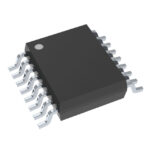 TAS5431QPWPRQ1
The activity of extra discounts on wholesale prices is in full swing…
Please fill in your contact information and we will send you the latest wholesale price list.





