ChipApex | Global Electronic Components Supplier
SEARCH
Search Product
Search Post
— IC芯片 | 连接器 | 传感器 | 被动器件 —
Search productSearch post
— IC芯片 | 连接器 | 传感器 | 被动器件 —
Consult the customer manager about the wholesale price.
consultation hotline:86-132-6715-2157
email:[email protected]
Contact the product manager for consultation. One-stop consultation is available.
Do you want a lower wholesale price? Please send us your inquiry and we will reply immediately.
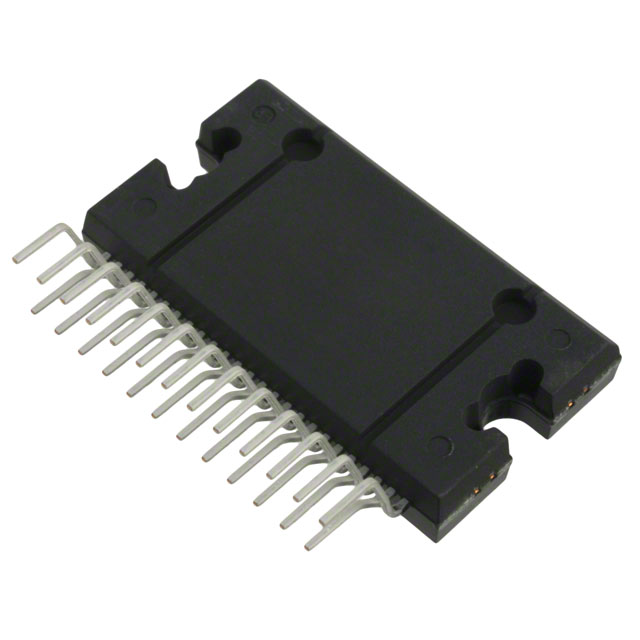
The TB2941HQ is a Bi-CMOS linear integrated circuit featuring four-channel BTL audio power amplification. It utilizes pure complementary P-ch and N-ch DMOS output stages to deliver maximum output power of 49 W at VCC = 15.2 V with THD = 10% and RL = 4 Ohms. The device operates within a supply voltage range of 6 V to 18 V for 4 Ohm loads, or 6 V to 16 V for 2 Ohm loads. Total harmonic distortion is typically 0.006% at 4 W output. The package is HZIP-25, weighing approximately 7.7 g.
Verify component authenticity through official Toshiba Semiconductor and Storage channels. Confirm the specific datasheet revision matches design requirements. Ensure proper thermal management is implemented as the device generates significant heat during operation. Check RoHS compliance status before integration into final products.
Select this component for designs requiring four-channel BTL amplification in automotive environments. Evaluate thermal dissipation capabilities against expected load conditions. Verify that external components like capacitors meet leakage current specifications to maintain stability. Consider the standby and mute control interfaces for system integration.
This part belongs to the TB2941 series of audio power amplifiers manufactured by Toshiba. It is designed specifically for high-power applications using DMOS technology. The device integrates multiple control features to simplify system design and enhance reliability in demanding automotive environments.
No public confirmed substitute part numbers are available in the provided documentation. Consult Toshiba sales representatives for potential alternatives if this component is discontinued or unavailable.
The device employs MPC/DFA technology to switch output voltages from Vcc/2 to Vcc/4 when headroom is suppressed. This reduces audible pop noise and sound cutting while maintaining voltage gain.
Thermal shutdown activates when the junction temperature exceeds 150°C. It first attenuates outputs, then mutes all channels, and finally shuts down if temperatures continue to rise.
 TB2941HQ
The activity of extra discounts on wholesale prices is in full swing…
Please fill in your contact information and we will send you the latest wholesale price list.