 ChipApex | Global Electronic Components Supplier
SEARCH
Search Product
Search Post
— IC芯片 | 连接器 | 传感器 | 被动器件 —
Search productSearch post
— IC芯片 | 连接器 | 传感器 | 被动器件 —
Consult the customer manager about the wholesale price.
consultation hotline:86-132-6715-2157
email:[email protected]
Contact the product manager for consultation. One-stop consultation is available.
Do you want a lower wholesale price? Please send us your inquiry and we will reply immediately.
The TDA7057AQ is a stereo BTL audio output amplifier manufactured by NXP Semiconductors, designed for integration into televisions, monitors, and battery-powered portable recorders. It features integrated DC volume control stages that eliminate the need for external coupling capacitors while maintaining low offset voltage. The device delivers up to 8 W of output power at 15 V supply with an 8 Ω load. Key electrical characteristics include a fixed maximum gain of 40.5 dB, a total harmonic distortion of 0.3% typical, and a quiescent current of 22 mA typical. It operates within a supply voltage range of 4.5 V to 18 V.
Verify the specific ordering suffix and package variant when sourcing this component. Confirm that the received datasheet matches the official NXP specification document number and revision date. Ensure compatibility with existing thermal management designs, as performance depends on proper heatsinking under high dissipation conditions.
Select this amplifier for applications requiring stereo BTL output with direct DC volume control integration. Consider the 13-lead plastic DIL-bent-SIL power package for mounting requirements. Evaluate thermal resistance calculations based on ambient temperature and expected sine wave power dissipation to ensure reliable operation within the specified junction temperature limits.
This component belongs to the TDA7057 series of audio amplifiers produced by Philips Semiconductors, now NXP. It serves as a specialized solution for consumer electronics where space and component count are critical constraints. The device represents a mature technology designed for robust performance in standard television and radio chassis architectures.
Consult official manufacturer documentation for confirmed substitute part numbers. Verify pinout compatibility and thermal characteristics before substituting any alternative devices.
The Missing Current Limiter (MCL) activates when the current difference between the output terminals of each amplifier exceeds 100 mA, allowing for single-ended headphone applications while protecting against short circuits.
At junction temperatures above 125 °C, the voltage gain decreases if it is higher than 0 dB, resulting in reduced output voltage and increased distortion levels.
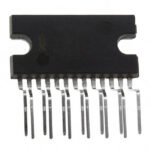 TDA7057AQ/N2,112
The activity of extra discounts on wholesale prices is in full swing…
Please fill in your contact information and we will send you the latest wholesale price list.






