 ChipApex | Global Electronic Components Supplier
SEARCH
Search Product
Search Post
— IC芯片 | 连接器 | 传感器 | 被动器件 —
Search productSearch post
— IC芯片 | 连接器 | 传感器 | 被动器件 —
Consult the customer manager about the wholesale price.
consultation hotline:86-132-6715-2157
email:[email protected]
Contact the product manager for consultation. One-stop consultation is available.
Do you want a lower wholesale price? Please send us your inquiry and we will reply immediately.
The TDA7498TR is a dual BTL Class-D audio amplifier from STMicroelectronics, designed for home systems and active speaker applications. It operates on a wide-range single supply of 14V to 39V. The device delivers 100W + 100W output power at THD=10% with a 6Ω load at 36V, or 80W + 80W with an 8Ω load at 34V. It features high efficiency (η=90%), four selectable fixed gain settings (25.6dB, 31.6dB, 35.1dB, 37.6dB), differential inputs, standby/mute functions, short-circuit protection, thermal overload protection, and external synchronizability in a 36-pin PowerSSO-36 EPU package.
Verify the specific suffix TR indicates tape-and-reel packaging when sourcing. Confirm the operating temperature range matches your environmental requirements, as variants may differ. Ensure the PowerSSO-36 EPU footprint aligns with your PCB layout, particularly regarding the exposed pad for heatsinking. Cross-reference the exact part number with official STMicroelectronics documentation to confirm current production status and RoHS compliance before finalizing procurement.
Select this component for applications requiring high power density and efficiency in a single-supply configuration. The differential input interface simplifies noise immunity in complex audio chains. Consider the available gain options to match source signal levels without additional pre-amplification. The exposed pad design facilitates effective thermal management for sustained high-power output in enclosed enclosures.
The TDA7498 belongs to STMicroelectronics' dedicated audio amplifier family, specifically targeting high-performance consumer audio. It complements other Class-D solutions by offering robust protection features and flexible gain configurations. The PowerSSO-36 package is optimized for thermal dissipation, supporting its role in demanding active speaker and home theater environments where reliability and sound quality are critical.
The TDA7498E series offers similar functionality but may vary in voltage range and output power specifications. Verify pin compatibility and thermal performance when substituting. Check datasheets for differences in gain settings and protection thresholds to ensure circuit stability.
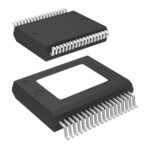 TDA7498TR
The activity of extra discounts on wholesale prices is in full swing…
Please fill in your contact information and we will send you the latest wholesale price list.






