 ChipApex | Global Electronic Components Supplier
SEARCH
Search Product
Search Post
— IC芯片 | 连接器 | 传感器 | 被动器件 —
Search productSearch post
— IC芯片 | 连接器 | 传感器 | 被动器件 —
Consult the customer manager about the wholesale price.
consultation hotline:86-132-6715-2157
email:[email protected]
Contact the product manager for consultation. One-stop consultation is available.
Do you want a lower wholesale price? Please send us your inquiry and we will reply immediately.
The TDA8563Q is a stereo BTL car radio power amplifier featuring two Class-B output stages. It delivers up to 40 W into 2 Ω or 25 W into 4 Ω loads at 10% THD with a 14.4 V supply. The device operates on a single supply voltage ranging from 6.0 V to 18 V, with a fixed closed-loop voltage gain of 26 dB. It includes comprehensive protection mechanisms such as thermal shutdown, short-circuit safety to ground and supply, reverse polarity protection, and load dump tolerance up to 45 V for 50 ms.
Verify the specific ordering suffix against the manufacturer's current documentation to confirm package type and tape/reel specifications. Ensure compatibility with the required lead length and mounting style for the target PCB design. Confirm that the procurement source provides valid traceability for this discontinued or legacy component series.
Select this component for applications requiring high efficiency and robust protection in automotive environments. Consider the 13-lead SIL package constraints and thermal resistance requirements when designing the heat dissipation path. Evaluate the need for external timing circuits to manage mute transitions and prevent switch-on plops during system initialization.
The TDA8563Q belongs to the Philips/NXP TDA85xx series of automotive audio power amplifiers. It is designed specifically for car radio applications, offering a balance of high output power and integrated diagnostics. The device supersedes earlier versions from January 1996, incorporating refined protection features and standardized packaging for modern manufacturing processes.
Check for direct replacements within the TDA8563 family or compatible TDA85xx series devices. Verify pinout compatibility and electrical parameter equivalence before substitution. Consult official NXP Semiconductors documentation for recommended alternative part numbers if the TDA8563Q is no longer available.
Pin 12 is an open-collector output that goes LOW during dynamic distortion clipping, short-circuit conditions, or when the junction temperature reaches 150 °C.
The mode select switch allows the user to control the amplifier state between operating, mute, and standby modes using a low-cost supply switch due to its low input current requirement.
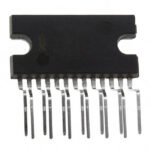 TDA8563Q/N2/S10,11
The activity of extra discounts on wholesale prices is in full swing…
Please fill in your contact information and we will send you the latest wholesale price list.





