 ChipApex | Global Electronic Components Supplier
SEARCH
Search Product
Search Post
— IC芯片 | 连接器 | 传感器 | 被动器件 —
Search productSearch post
— IC芯片 | 连接器 | 传感器 | 被动器件 —
Consult the customer manager about the wholesale price.
consultation hotline:86-132-6715-2157
email:[email protected]
Contact the product manager for consultation. One-stop consultation is available.
Do you want a lower wholesale price? Please send us your inquiry and we will reply immediately.
The TDF8541TH/N2,518 is an I2C-bus controlled quad Bridge-Tied Load (BTL) audio power amplifier designed for automotive applications. It utilizes a complementary DMOS output stage in an SOI-based BCD process to ensure robust performance and high sound quality. The device operates at battery voltages as low as 6 V, supporting stop/start-car functionality without audible disturbances. It features full diagnostics, including start-up checks, speaker fault detection, and thermal protection. The amplifier can drive 2 Ω and 4 Ω loads with programmable gain settings of 26 dB or 16 dB.
Verify the specific ordering suffix N2,518 corresponds to the HSOP36 package variant. Confirm that the source document explicitly supports this suffix for functional equivalence. Check for any regional distribution restrictions or end-of-life status updates from NXP Semiconductors before finalizing procurement plans.
Select this component when designing automotive audio systems that require I2C controllability and extensive diagnostic features. Ensure the design accommodates the HSOP36 package thermal requirements. Verify compatibility with the target microcontroller's I2C bus voltage levels, as the device supports both 3.3 V and 5 V compliant interfaces.
The TDF8541 series represents a generation of complementary quad BTL audio power amplifiers optimized for automotive environments. It succeeds predecessors like the TDA8594 and TDA8595, offering enhanced software and hardware compatibility. The TH variant specifically denotes the heatsink small outline package, providing a compact solution for space-constrained automotive PCB layouts while maintaining high power output capabilities.
Official substitutes within the TDF8541 family include TDF8541J/N2, TDF8541SD/N2, and TDF8541JS/N2. These variants share identical electrical characteristics but differ in package type. Ensure the replacement package matches the mechanical constraints of the existing design. No other part numbers are confirmed as direct replacements by the manufacturer datasheet.
The amplifier uses a capacitor on pin SVR to create a reference voltage that follows the supply voltage slowly. This prevents common mode ripple and ensures the DC input bias voltage tracks the supply, avoiding sudden output shifts. Additionally, fast mute and soft mute functions are activated if the battery voltage drops below 6 V.
The ADSEL pin allows for hardware programming of up to four different I2C-bus addresses. By connecting a resistor between ADSEL and ground, a specific address can be emulated. If ADSEL is shorted to ground, the device operates in legacy mode, disabling the I2C-bus interface.
During the initial start-up diagnostics cycle, the amplifier cannot reliably distinguish between a short-to-ground and a speaker fault. Both conditions may result in the channel being switched off. However, continuous speaker fault detection operates after start-up, setting specific diagnostic bits without necessarily shutting down the channel.
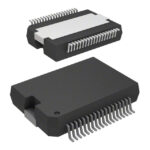 TDF8541TH/N2,518
The activity of extra discounts on wholesale prices is in full swing…
Please fill in your contact information and we will send you the latest wholesale price list.






