 ChipApex | Global Electronic Components Supplier
SEARCH
Search Product
Search Post
— IC芯片 | 连接器 | 传感器 | 被动器件 —
Search productSearch post
— IC芯片 | 连接器 | 传感器 | 被动器件 —
Consult the customer manager about the wholesale price.
consultation hotline:86-132-6715-2157
email:[email protected]
Contact the product manager for consultation. One-stop consultation is available.
Do you want a lower wholesale price? Please send us your inquiry and we will reply immediately.
The TDF8546J/N2ZU is a complementary quad Bridge-Tied Load (BTL) audio power amplifier designed for automotive applications. It operates on a supply voltage range of 6 V to 18 V and delivers up to 45 W per channel into a 4 Ω load at 15.2 V, or 64 W into a 2 Ω load at 14.4 V. The device utilizes an I²C-bus interface for control and diagnostics, supporting both legacy and digital modes. It features a patented best efficiency mode that reduces power dissipation by over 65% compared to standard BTL configurations under correlated signals. The amplifier incorporates comprehensive protection mechanisms including thermal pre-warning, clip detection, and speaker fault diagnosis.
Verify the specific ordering suffix against the manufacturer's current documentation to confirm package type and lead-free status. Ensure the design supports the required I²C bus addressing and thermal management for the DBS27P package. Confirm that the application environment meets the specified operating temperature and voltage ranges defined in the product data sheet.
Select this component when designing automotive audio systems requiring high output power with strict thermal constraints. The integrated best efficiency mode is critical for reducing heat generation in enclosed vehicle environments. Ensure the host controller supports the necessary I²C communication protocol for configuring gain, mute states, and diagnostic feedback.
The TDF8546 series represents a generation of complementary quad BTL audio power amplifiers intended for automotive use. It succeeds earlier models like the TDA8589XJ while offering enhanced efficiency and diagnostic capabilities. The J variant specifically denotes the plastic DIL-bent-SIL power package, distinguishing it from surface-mount alternatives within the same functional family.
The TDF8546J is software and hardware downwards-compatible with the predecessor TDA8589XJ. Designers migrating from the TDA8589XJ can utilize the TDF8546J with minimal circuit modifications, provided the I²C bus configuration is updated to leverage the new diagnostic features.
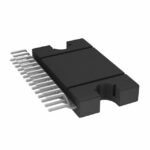 TDF8546J/N2ZU
The activity of extra discounts on wholesale prices is in full swing…
Please fill in your contact information and we will send you the latest wholesale price list.





