 ChipApex | Global Electronic Components Supplier
SEARCH
Search Product
Search Post
— IC芯片 | 连接器 | 传感器 | 被动器件 —
Search productSearch post
— IC芯片 | 连接器 | 传感器 | 被动器件 —
Consult the customer manager about the wholesale price.
consultation hotline:86-132-6715-2157
email:[email protected]
Contact the product manager for consultation. One-stop consultation is available.
Do you want a lower wholesale price? Please send us your inquiry and we will reply immediately.
The TDF8591TH is a high-efficiency Class-D audio power amplifier designed for automotive applications. It delivers 2 × 100 W into 4 Ω in Single-Ended (SE) mode or 1 × 310 W into 4 Ω in Bridge-Tied Load (BTL) mode. The device operates on a supply voltage range of ±14 V to ±29 V and features low quiescent current consumption. It includes thermal foldback, overtemperature protection, and short-circuit proof outputs.
Verify the specific ordering suffix against the manufacturer's official documentation to ensure correct package and tape/reel specifications. Confirm that the component meets AEC-Q100 qualification requirements for your automotive application. Check for any end-of-life notices or alternative part recommendations from NXP Semiconductors before finalizing procurement plans.
Select this amplifier for applications requiring high power density and efficiency in automotive environments. Ensure the design accommodates the required supply voltage range of ±14 V to ±29 V. Consider the thermal management needs based on the expected load impedance and operating temperature. Verify compatibility with differential input stages and external clock synchronization if multiple units are used.
The TDF8591TH belongs to NXP's family of high-efficiency Class-D audio amplifiers. It utilizes SOI BCDMOS technology for low power dissipation. The device is housed in an HSOP24 power package with a small internal heat sink, reducing the need for external heatsinks in many applications.
Consult NXP Semiconductors' official obsolescence notices and replacement guides for verified substitute part numbers. Do not assume cross-compatibility with other series without verifying pinout and electrical specifications.
The oscillator frequency is set by an external resistor connected between the OSC pin and VSSA. An optimum setting is between 300 kHz and 350 kHz, typically achieved with a 30 kΩ resistor.
The device includes Thermal Foldback, Overtemperature Protection, OverCurrent Protection, Window Protection, UnderVoltage Protection, OverVoltage Protection, and Unbalance Protection.
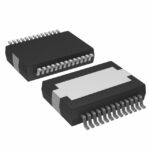 TDF8591TH/N1TJ
The activity of extra discounts on wholesale prices is in full swing…
Please fill in your contact information and we will send you the latest wholesale price list.





