 ChipApex | Global Electronic Components Supplier
SEARCH
Search Product
Search Post
— IC芯片 | 连接器 | 传感器 | 被动器件 —
Search productSearch post
— IC芯片 | 连接器 | 传感器 | 被动器件 —
Consult the customer manager about the wholesale price.
consultation hotline:86-132-6715-2157
email:[email protected]
Contact the product manager for consultation. One-stop consultation is available.
Do you want a lower wholesale price? Please send us your inquiry and we will reply immediately.
The TDTA123J is a silicon PNP epitaxial type digital transistor manufactured by Toshiba Electronic Devices & Storage Corporation. It integrates bias resistors to simplify circuit design and reduce component count. The device features a supply voltage rating of -50 V, an output current capacity of -100 mA, and a power dissipation limit of 320 mW. Key electrical parameters include a DC current gain (GI) minimum of 80 at -10 mA collector current, an input resistance (R1) typical value of 2.2 kΩ, and a transition frequency (fT) of 250 MHz. The unit is housed in an SOT-23 package.
Verify the specific ordering code suffix against the official Toshiba datasheet to confirm packaging quantity and tape-and-reel specifications. Confirm RoHS compliance status with the manufacturer or authorized distributor prior to procurement. Ensure the selected variant matches the required automotive or industrial reliability standards if applicable to the target application environment.
Select this component when a PNP digital transistor with integrated biasing is required for switching or inverter topologies. Verify that the -50 V supply voltage and -100 mA output current ratings exceed the maximum operational requirements of the target circuit. Consider the complementary TDTC123J if an NPN equivalent is needed for push-pull configurations.
The TDTA123J belongs to the family of resistor-equipped bipolar transistors designed to replace discrete resistor-transistor networks. Commercial production began in March 2016. It serves as a direct complement to the TDTC123J NPN device, offering a standardized solution for logic interface and driver stages where space efficiency and simplified bill of materials are prioritized.
Cross-reference with other manufacturers' PNP digital transistors featuring similar R1/R2 ratios and SOT-23 packaging. Verify pinout compatibility and absolute maximum ratings before substitution. Note that internal resistor tolerances may vary between different brand equivalents.
The resistance ratio (R2/R1) has a typical value of 21, with a minimum of 17 and a maximum of 26.
The transition frequency is typically 250 MHz, measured at VCE = -10 V, IE = 5 mA, and f = 100 MHz.
No. Toshiba explicitly states that the product is neither intended nor warranted for use in equipment requiring extraordinarily high levels of quality and reliability, such as nuclear facilities or aerospace industry equipment.
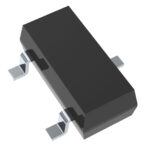 TDTA123J,LM
The activity of extra discounts on wholesale prices is in full swing…
Please fill in your contact information and we will send you the latest wholesale price list.






