 ChipApex | Global Electronic Components Supplier
SEARCH
Search Product
Search Post
— IC芯片 | 连接器 | 传感器 | 被动器件 —
Search productSearch post
— IC芯片 | 连接器 | 传感器 | 被动器件 —
Consult the customer manager about the wholesale price.
consultation hotline:86-132-6715-2157
email:[email protected]
Contact the product manager for consultation. One-stop consultation is available.
Do you want a lower wholesale price? Please send us your inquiry and we will reply immediately.
The TDTC114E is a silicon NPN epitaxial type digital transistor manufactured by Toshiba Electronic Devices & Storage Corporation. It integrates bias resistors to reduce external component count and system size. The device operates with a supply voltage of 50 V and a continuous output current of 100 mA, dissipating up to 320 mW. Key electrical parameters include an input resistance (R1) of 10 kΩ, a resistance ratio (R2/R1) of 1.0, and a DC current gain (GI) minimum of 30. The transition frequency (fT) is typically 250 MHz. It is housed in an SOT-23 package.
Verify the specific ordering suffix against the official Toshiba datasheet to confirm packaging details such as tape and reel quantities or cut tape options. Confirm RoHS compliance status directly with the manufacturer or authorized distributor before procurement. Ensure the design accounts for derating concepts outlined in the Toshiba Semiconductor Reliability Handbook for long-term reliability under heavy loads.
Select this component when a single NPN digital transistor with built-in bias resistors is required for switching or inverter applications. The 10 kΩ input resistance and unity resistance ratio are suitable for standard logic interface circuits. Consider the complementary TDTA114E if a matched PNP pair is needed. Verify that the 50 V collector-emitter voltage and 100 mA current ratings meet the specific load requirements of the target application.
The TDTC114E belongs to the series of bipolar transistors featuring monolithic bias resistor networks. These devices are designed to replace discrete resistor-transistor combinations, simplifying circuit layout. The product line includes various resistance values to accommodate different drive conditions, with the TDTC114E specifically offering a 10 kΩ input resistance configuration.
The datasheet identifies the TDTA114E as the complementary PNP type. No other direct substitute part numbers are explicitly listed in the provided documentation. Cross-referencing with other manufacturers requires verifying pinout compatibility, electrical ratings, and package dimensions.
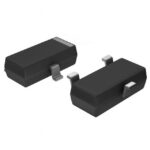 TDTC114E,LM
The activity of extra discounts on wholesale prices is in full swing…
Please fill in your contact information and we will send you the latest wholesale price list.





