 ChipApex | Global Electronic Components Supplier
SEARCH
Search Product
Search Post
— IC芯片 | 连接器 | 传感器 | 被动器件 —
Search productSearch post
— IC芯片 | 连接器 | 传感器 | 被动器件 —
Consult the customer manager about the wholesale price.
consultation hotline:86-132-6715-2157
email:[email protected]
Contact the product manager for consultation. One-stop consultation is available.
Do you want a lower wholesale price? Please send us your inquiry and we will reply immediately.
The TE0820-03 is a 4 x 5 cm industrial-grade System on Module integrating a Xilinx Zynq UltraScale+ MPSoC with up to 4 GByte DDR4 SDRAM and 128 MByte SPI Flash. It features dual Cortex-R5 real-time cores, quad-core or dual-core Cortex-A53 application processors, and four high-speed serial I/O interfaces supporting PCIe, SATA, DisplayPort, USB 3.0, and GMII. The module includes an integrated Marvell Gigabit Ethernet PHY, Microchip USB ULPI transceiver, Lattice CPLD for system control, and eMMC storage.
Verify the specific processor variant (XCZU2CG/EG or XCZU3CG/EG) required for your performance needs, as core counts vary by assembly option. Confirm that the carrier board supports the 2x100-pin and 1x60-pin Hermaphroditic connector mating heights. Ensure the design accommodates the specified voltage levels for the B2B I/Os, which are primarily 1.8V. Check for any specific boot mode configurations needed via the CPLD firmware.
Select this module when a compact form factor is critical alongside high-performance mixed-signal processing capabilities. It is suitable for designs requiring multiple high-speed serial protocols like PCIe and SATA without external bridge chips. Consider the available memory options if standard 2GB DDR4 is insufficient. Evaluate the thermal requirements of the Zynq UltraScale+ device under your specific load conditions.
This module belongs to Trenz Electronic's 4 x 5 cm SoM family, designed for mechanical compatibility across variants. It serves as a central processing unit for carrier boards, abstracting complex PCB layout requirements for high-speed signals. The TE0820 series leverages Xilinx Zynq UltraScale+ technology to combine programmable logic with ARM processing subsystems in a single package.
Direct replacements depend on the specific Zynq UltraScale+ variant used. Verify pinout compatibility with existing carrier boards if swapping between different MPSoC densities within the same package. Alternative modules from other vendors may require significant schematic and layout changes due to differing connector standards and peripheral integrations.
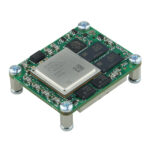 TE0820-03-03EG-1EA
The activity of extra discounts on wholesale prices is in full swing…
Please fill in your contact information and we will send you the latest wholesale price list.






