 ChipApex | Global Electronic Components Supplier
SEARCH
Search Product
Search Post
— IC芯片 | 连接器 | 传感器 | 被动器件 —
Search productSearch post
— IC芯片 | 连接器 | 传感器 | 被动器件 —
Consult the customer manager about the wholesale price.
consultation hotline:86-132-6715-2157
email:[email protected]
Contact the product manager for consultation. One-stop consultation is available.
Do you want a lower wholesale price? Please send us your inquiry and we will reply immediately.
The TIBPAL20R6-15CNT is a high-performance IMPACT PAL circuit featuring 12 inputs and 6 registered outputs with 3-state buffers. It operates at a maximum clock frequency of 45 MHz without feedback, with a typical propagation delay of 12 ns from input to output and 8 ns from clock to Q. The device supports a nominal supply voltage of 5 V, drawing up to 180 mA. It is characterized for operation within an ambient temperature range of 0 °C to 75 °C.
Verify the specific suffix 'CNT' against official Texas Instruments documentation to confirm package type and material composition, as standard datasheets list JT, NT, FN, or FK packages. Confirm that the component meets current environmental compliance standards, noting that older production data may indicate non-RoHS status. Ensure the source provides valid traceability for this obsolete series.
Select the TIBPAL20R6 variant when six registered outputs with three-state control are required alongside twelve general-purpose inputs. Choose the -15C speed grade for applications operating within commercial temperature limits (0 °C to 75 °C) requiring up to 45 MHz performance. Consider the -20M series if military-grade temperature ranges (-55 °C to 125 °C) are necessary, accepting a slightly lower maximum frequency of 41.6 MHz.
This device belongs to the Texas Instruments IMPACT PAL family, designed as high-performance substitutes for conventional TTL logic. The series utilizes proven programmable array logic architecture to enable rapid custom function development. These circuits are intended for designs prioritizing speed and functional density while maintaining compatibility with existing TTL voltage levels and interface standards.
The TIBPAL20R6-15C is functionally equivalent to the AMD PAL20R6. When substituting, verify pinout compatibility and ensure the replacement device supports the required 3-state output buffering. Confirm that the substitute matches the electrical characteristics, particularly the propagation delays and supply current limits, for the target operating environment.
Upon power-up, all internal registers are automatically reset to a zero state. This ensures a known initial condition for state machines, though output pin voltages may go high depending on the specific logic configuration.
Preloading requires raising Pin 13 to VIHH while Pin 1 is at VIL. Apply the desired data level to the specific output pin, pulse Pin 1 to clock the data into the register, then remove the output voltage and lower Pin 13 back to VIL.
The -15C series is characterized for commercial temperatures (0 °C to 75 °C) with a max clock frequency of 45 MHz. The -20M series is characterized for military temperatures (-55 °C to 125 °C) with a max clock frequency of 41.6 MHz.
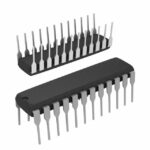 TIBPAL20R6-15CNT
The activity of extra discounts on wholesale prices is in full swing…
Please fill in your contact information and we will send you the latest wholesale price list.





