 ChipApex | Global Electronic Components Supplier
SEARCH
Search Product
Search Post
— IC芯片 | 连接器 | 传感器 | 被动器件 —
Search productSearch post
— IC芯片 | 连接器 | 传感器 | 被动器件 —
Consult the customer manager about the wholesale price.
consultation hotline:86-132-6715-2157
email:[email protected]
Contact the product manager for consultation. One-stop consultation is available.
Do you want a lower wholesale price? Please send us your inquiry and we will reply immediately.
The TLC5920DLRG4 is a linear LED driver IC manufactured by Texas Instruments, designed for high-channel-count lighting applications. It features 16 constant-current outputs capable of delivering up to 30mA per channel. The device operates within a supply voltage range of 4.5V to 5.5V and supports a clock frequency of up to 10MHz. It utilizes a shift register topology for data input and is housed in a 48-SSOP package with an operating temperature range of -20°C to 85°C.
Verify component authenticity through authorized distributors or direct manufacturer channels. Confirm the specific suffix 'G4' indicates RoHS compliance status as documented in official datasheets. Check for obsolescence notices, as this part may be discontinued at certain retail levels despite being listed in some catalogs. Ensure the 48-SSOP package dimensions match your PCB footprint requirements before finalizing procurement.
Select this component when a high number of individually controlled LED channels is required without complex multiplexing. The linear topology suits applications where thermal management can handle dissipation from constant current regulation. Consider the 10MHz clock speed if high refresh rates are necessary. Evaluate the 48-pin SSOP package constraints against available board space and soldering capabilities.
This part belongs to the TLC5920 family of LED drivers, which are designed for driving large arrays of LEDs. The 'DLRG4' designation specifies the tape-and-reel packaging variant and environmental compliance. It serves as a bridge between digital control logic and analog LED current requirements, simplifying design complexity for multi-channel lighting projects.
Publicly confirmed substitute part numbers include the TLC5920DLR and TLC5920DLG4. These variants share identical electrical specifications and pinouts but differ primarily in packaging format or environmental certification suffixes. Verify that any replacement maintains the 48-SSOP form factor and 16-channel architecture to ensure compatibility with existing designs.
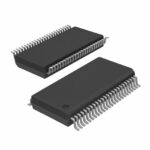 TLC5920DLRG4
The activity of extra discounts on wholesale prices is in full swing…
Please fill in your contact information and we will send you the latest wholesale price list.





