 ChipApex | Global Electronic Components Supplier
SEARCH
Search Product
Search Post
— IC芯片 | 连接器 | 传感器 | 被动器件 —
Search productSearch post
— IC芯片 | 连接器 | 传感器 | 被动器件 —
Consult the customer manager about the wholesale price.
consultation hotline:86-132-6715-2157
email:[email protected]
Contact the product manager for consultation. One-stop consultation is available.
Do you want a lower wholesale price? Please send us your inquiry and we will reply immediately.
The TLV990BPFB is a single-chip CCD and video signal processor designed for video camcorder applications. It integrates a correlated double sampler (CDS), a programmable gain amplifier (PGA) with a 0 to 36-dB range, and a 10-bit, 28-MSPS pipeline analog-to-digital converter (ADC). The device operates from a single 3-V analog supply and a 1.8-V to 4.4-V digital interface supply, consuming 150 mW at full speed and 2 mW in power-down mode. It features automatic or programmable optical black level calibration, two internal DACs for offset correction, and additional user DACs for external system control.
Verify the package designation PFB corresponds to the 48-pin TQFP form factor. Confirm the operating temperature range is –20°C to 75°C for this specific suffix. Ensure the serial interface configuration matches the required SCLK polarity via the SCKP pin. Check that the DIVDD supply voltage aligns with the 1.8 V to 4.4 V specification for digital logic levels.
Select this component when a fully integrated CCD front-end solution is required with high-speed digitization. The PGA gain range must accommodate the specific dynamic range of the target CCD sensor. Verify that the 10-bit resolution meets the application's noise floor requirements. Ensure the system can provide the necessary SR and SV sample clocks for the CDS operation.
The TLV990B is part of Texas Instruments' area CCD and video signal processor family. The BPFB suffix indicates the commercial temperature grade (-20°C to 75°C) and the 48-pin TQFP packaging. This device consolidates multiple discrete analog processing stages into a single CMOS IC to reduce board space and power consumption in portable video equipment.
Publicly confirmed substitute part numbers are not available in the provided documentation. Evaluate compatibility based on pinout, supply voltages, and register configurations if considering alternative CCD processors.
The PGA gain is digitally controlled via a 10-bit serial register, allowing adjustment from 0 dB to 36 dB with a resolution of 0.045 dB per step.
The OBCLP pin activates the automatic optical black level and offset calibration sequence when pulled low.
Yes, by setting the INM bit in Control Register 2 to 1, the device enables the video channel connected to the VIDEOIN pin, supporting both autoclamp and manual clamp modes.
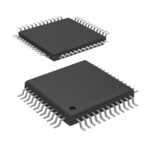 TLV990BPFB
The activity of extra discounts on wholesale prices is in full swing…
Please fill in your contact information and we will send you the latest wholesale price list.





