 ChipApex | Global Electronic Components Supplier
SEARCH
Search Product
Search Post
— IC芯片 | 连接器 | 传感器 | 被动器件 —
Search productSearch post
— IC芯片 | 连接器 | 传感器 | 被动器件 —
Consult the customer manager about the wholesale price.
consultation hotline:86-132-6715-2157
email:[email protected]
Contact the product manager for consultation. One-stop consultation is available.
Do you want a lower wholesale price? Please send us your inquiry and we will reply immediately.
The TMA56S-L is a Triac (Bidirectional Triode Thyristor) from the Sanken TMA5x Series, designed for AC power control applications. It features a peak repetitive off-state voltage (VDRM) of 600 V and a peak non-repetitive off-state voltage (VDSM) of 700 V. The device supports an RMS on-state current (IT(RMS)) of 5 A at a case temperature of 102°C, with surge capabilities of 53 A at 60 Hz and 50 A at 50 Hz. It operates within a junction temperature range of -40 to 125 °C and provides an isolation voltage of 1800 V AC RMS between lead and case. The component is housed in a 3-pin fully molded SIP package (TO-220F) with a heatsink mounting option.
Verify that the specific part number matches the required voltage rating, as the TMA5x series includes variants with different VDRM values. Confirm compliance with RoHS requirements and check for UL Recognized Component status if safety certification is mandatory for the target application. Ensure storage conditions remain within standard temperature and humidity limits to prevent lead rust or solderability issues before assembly.
Select the TMA56S-L when a 600 V blocking voltage is required, distinguishing it from the 400 V TMA54x variant. Consider the TO-220F package for applications needing direct heatsink mounting to manage thermal resistance. Evaluate the 5 A RMS current rating against the maximum load requirements, accounting for derating at higher case temperatures. Verify gate trigger characteristics align with the driving controller's output capabilities across the operating temperature range.
The TMA56S-L belongs to the TMA5x Series of Triacs manufactured by Sanken Electric Co., Ltd. This series is engineered for general-purpose electronic equipment and offers uniform switching performance. The product line includes both 400 V and 600 V versions, packaged in a compact SIP format suitable for various AC power control tasks in consumer and office electronics.
The TMA54S-L serves as a lower voltage alternative within the same series, offering a 400 V VDRM rating instead of 600 V. Designers must verify that the reduced voltage rating meets the circuit requirements before substituting this component.
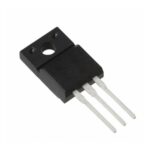 TMA56S-L
The activity of extra discounts on wholesale prices is in full swing…
Please fill in your contact information and we will send you the latest wholesale price list.





