 ChipApex | Global Electronic Components Supplier
SEARCH
Search Product
Search Post
— IC芯片 | 连接器 | 传感器 | 被动器件 —
Search productSearch post
— IC芯片 | 连接器 | 传感器 | 被动器件 —
Consult the customer manager about the wholesale price.
consultation hotline:86-132-6715-2157
email:[email protected]
Contact the product manager for consultation. One-stop consultation is available.
Do you want a lower wholesale price? Please send us your inquiry and we will reply immediately.
The TPA2000D1PWR is a 2-W mono bridge-tied-load (BTL) Class-D audio power amplifier from Texas Instruments. It operates on a single supply voltage ranging from 2.7 V to 5.5 V and delivers 2 W of continuous output power into a 4-Ω load with less than 1% THD+N at 1 kHz. The device utilizes third-generation modulation technology optimized for filterless operation, eliminating the need for external LC filters while maintaining high efficiency. It features four internal gain settings selectable via digital inputs, integrated depop circuitry to minimize startup noise, and comprehensive protection mechanisms including short-circuit and thermal shutdown.
Verify the specific package variant when ordering; the 'PW' suffix indicates a 16-pin TSSOP package, while 'GQC' denotes a MicroStar Junior BGA. Confirm that the 'R' suffix in part numbers like TPA2000D1PWR specifies tape-and-reel packaging. Ensure the design supports the -40°C to 85°C operating temperature range and matches the required gain configuration via GAIN0 and GAIN1 pins.
Select this component for applications prioritizing high efficiency and minimal external component count. It is suitable for systems where space constraints prevent the use of bulky output filters. Designers must account for variable input impedance across different gain settings when configuring the input coupling capacitor to maintain desired low-frequency response characteristics.
This device belongs to Texas Instruments' third-generation Class-D audio amplifier family. It is designed as a cost-effective solution for driving small speakers in portable electronics. The TPA2000D1 serves as a bridge-tied-load amplifier, allowing double the voltage swing across the load compared to single-ended configurations, thereby maximizing output power within low-voltage supply limits.
TPA2000D1PW
It uses a unique modulation scheme where the outputs switch in phase rather than being 180 degrees out of phase. This significantly reduces ripple current through the speaker, minimizing I²R losses and allowing direct connection without an LC filter.
Gain is set internally by applying logic levels to the GAIN0 and GAIN1 pins. The available settings are 6 dB, 12 dB, 18 dB, and 23.5 dB, which also determine the input impedance.
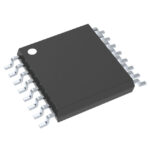 TPA2000D1PWR
The activity of extra discounts on wholesale prices is in full swing…
Please fill in your contact information and we will send you the latest wholesale price list.





