 ChipApex | Global Electronic Components Supplier
SEARCH
Search Product
Search Post
— IC芯片 | 连接器 | 传感器 | 被动器件 —
Search productSearch post
— IC芯片 | 连接器 | 传感器 | 被动器件 —
Consult the customer manager about the wholesale price.
consultation hotline:86-132-6715-2157
email:[email protected]
Contact the product manager for consultation. One-stop consultation is available.
Do you want a lower wholesale price? Please send us your inquiry and we will reply immediately.
The TPA2000D2PWPG4 is a stereo Class-D audio power amplifier in a 24-pin TSSOP or HTSSOP package. It delivers 2 W into 3-Ω speakers with THD+N < 0.4%. The device operates from a 5-V supply, drawing 8 mA without an output filter and 1 µA in shutdown mode. Key electrical parameters include a -77 dB PSRR, 56 µV RMS noise floor, and switching frequency of 200–300 kHz. Gain settings range from 8 to 23.5 dB via GAIN0/GAIN1 pins.
Verify the PG4 suffix indicates lead-free and RoHS compliance per Texas Instruments standards. Confirm the PW or PWP package variant matches your PCB footprint requirements. Ensure the ordering suffix aligns with tube or tape-and-reel preferences if applicable. Cross-reference the datasheet revision date to confirm current production status and parameter validity before finalizing procurement.
Select this component for applications requiring high efficiency at low voltages. The filterless design reduces BOM cost and PCB area significantly compared to traditional Class-D amplifiers. Consider input impedance variations when designing the source coupling network. Ensure adequate decoupling capacitors are placed near PVDD and VDD pins to maintain stability and minimize THD.
This device belongs to Texas Instruments' third-generation 5-V Class-D amplifier family. It improves upon previous generations by offering lower supply current, reduced noise floor, and smaller packaging. The monolithic CMOS architecture integrates power MOSFETs for bridge-tied load (BTL) configuration, eliminating the need for external output coupling capacitors.
Check for direct pin-compatible upgrades within the TPA2000 series. Verify that alternative devices support the same 5-V supply voltage and differential input requirements. Ensure replacement parts offer comparable thermal performance and protection features for your specific application environment.
Yes, the device uses a modulation scheme optimized to operate without an output filter, saving system cost and PCB area.
Gain is set internally using the GAIN0 and GAIN1 digital input pins, offering four settings from 8 dB to 23.5 dB.
The device includes short-circuit protection (to battery, ground, and load), thermal shutdown, over-current detection, and under-voltage lockout.
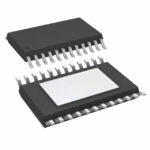 TPA2000D2PWPG4
The activity of extra discounts on wholesale prices is in full swing…
Please fill in your contact information and we will send you the latest wholesale price list.





