 ChipApex | Global Electronic Components Supplier
SEARCH
Search Product
Search Post
— IC芯片 | 连接器 | 传感器 | 被动器件 —
Search productSearch post
— IC芯片 | 连接器 | 传感器 | 被动器件 —
Consult the customer manager about the wholesale price.
consultation hotline:86-132-6715-2157
email:[email protected]
Contact the product manager for consultation. One-stop consultation is available.
Do you want a lower wholesale price? Please send us your inquiry and we will reply immediately.
The UC-P3010-H30 is a Class H linear audio amplifier ASIC from USound’s Tarvos 1.0 family, designed for 3.6 V Li-Ion supplies. It features an integrated DC-DC boost converter generating up to 27 VPP output within a 20 Hz–80 kHz frequency range. The device offers selectable gains of 18, 24, or 30 dB and maintains sub-mA quiescent current draw. It supports load capacitance up to 50 nF and delivers THD+N of 103 dB. Packaged in a compact 16-ball 2x2 mm² WLCSP, it includes built-in DC bias voltage sourcing and I2C factory programming interfaces.
Verify the specific suffix configuration matches your target MEMS series; the H30 variant is explicitly configured for Conamara series speakers at 30 dB gain. Confirm that external components such as the boost inductor and Schottky diode meet the specified saturation current and leakage requirements to maintain efficiency. Ensure PCB layout guidelines for the DC-DC section are strictly followed to prevent instability. Check for any updated revision history regarding pin definitions or electrical characteristics before finalizing design integration.
Select this component when driving USound Conamara MEMS speakers requiring high peak voltages from a single-cell lithium-ion battery. The H30 designation indicates a fixed 30 dB gain configuration tailored for specific Conamara models like UA-C0603-3F. Consider the G-series variants if using Ganymede speakers instead. Evaluate the need for I2C factory programming versus fixed gain settings based on production volume and calibration requirements. Ensure the application environment stays within the specified junction temperature limits for reliable operation.
This part belongs to the Tarvos 1.0 family of high-voltage linear audio amplifiers developed by USound GmbH. It is specifically engineered to interface directly with piezoelectric and MEMS acoustic transducers that require significant voltage swings beyond standard logic levels. The H30 suffix denotes the H-configuration optimized for Conamara series products, distinguishing it from G-configuration variants used with Ganymede series speakers.
No direct public substitute part numbers are documented for this specific configuration. Alternative solutions would require redesigning the boost converter circuitry and gain stages. Verify compatibility with existing MEMS drivers if considering different gain configurations within the same Tarvos family.
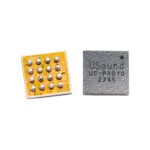 UC-P3010-H30
The activity of extra discounts on wholesale prices is in full swing…
Please fill in your contact information and we will send you the latest wholesale price list.






