 ChipApex | Global Electronic Components Supplier
SEARCH
Search Product
Search Post
— IC芯片 | 连接器 | 传感器 | 被动器件 —
Search productSearch post
— IC芯片 | 连接器 | 传感器 | 被动器件 —
Consult the customer manager about the wholesale price.
consultation hotline:86-132-6715-2157
email:[email protected]
Contact the product manager for consultation. One-stop consultation is available.
Do you want a lower wholesale price? Please send us your inquiry and we will reply immediately.
The UCC5680PW24TR is a low-voltage differential (LVD) Small Computer System Interface (SCSI) terminator manufactured by Texas Instruments. It operates within a supply voltage range of 2.7 V to 5.25 V and supports an operating temperature range of 0°C to 70°C. The device provides 105 Ω differential impedance and 150 Ω common-mode impedance in LVD mode, with a typical differential bias voltage of 125 mV. It features a built-in SPI-3 mode change delay filter ranging from 100 ms to 300 ms. The component detects bus driver types via the DIFFSENS line and disconnects if single-ended or high-voltage differential drivers are present. It is housed in a 24-pin TSSOP package.
Verify the specific ordering suffix 'TR' indicates tape and reel packaging containing 2,000 units per reel. Confirm the '24' designation corresponds to the 24-pin TSSOP package variant rather than the 28-pin version. Ensure the component status is listed as Active for new designs. Check for RoHS compliance and lead finish specifications such as CU NIPDAU in the latest manufacturer documentation before finalizing orders.
Select this component specifically for LVD-only SCSI applications where automatic detection of incompatible SE or HVD drivers is required. Ensure the design accommodates the 100 ms to 300 ms mode change delay inherent to the device. Verify that the board layout adheres to strict capacitance limits defined for Ultra320 speeds. Consider using three devices per bus end to terminate all data and control lines effectively.
The UCC5680 series serves as a specialized terminator for SCSI interfaces, addressing the transition from High-Voltage Differential (HVD) to Low-Voltage Differential (LVD) signaling. The PW24 variant specifically offers a 24-pin form factor suitable for compact PCB layouts. It complements other SCSI interface components by handling the complex termination requirements mandated by evolving SCSI standards like SPI-3.
The UCC5680PW24G4 is a lead-free equivalent of the standard UCC5680PW24. Designers should verify pin compatibility and electrical characteristics remain identical between the G4 and non-G4 variants before substitution.
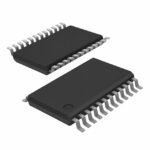 UCC5680PW24TR
The activity of extra discounts on wholesale prices is in full swing…
Please fill in your contact information and we will send you the latest wholesale price list.





