 ChipApex | Global Electronic Components Supplier
SEARCH
Search Product
Search Post
— IC芯片 | 连接器 | 传感器 | 被动器件 —
Search productSearch post
— IC芯片 | 连接器 | 传感器 | 被动器件 —
Consult the customer manager about the wholesale price.
consultation hotline:86-132-6715-2157
email:[email protected]
Contact the product manager for consultation. One-stop consultation is available.
Do you want a lower wholesale price? Please send us your inquiry and we will reply immediately.
The ULN2001D1013TR is a high-voltage, high-current Darlington transistor array manufactured by STMicroelectronics. It integrates seven NPN Darlington pairs with common emitters in a single SOIC-16 surface-mount package. Each channel provides an output current rating of 500 mA and can withstand peak currents up to 600 mA. The device features a collector-emitter breakdown voltage (Vceo) of 50 V and a minimum DC current gain (hFE) of 1000 at 350 mA. Integrated suppression diodes are included for driving inductive loads. The component operates within a temperature range of -20°C to +85°C.
Verify the specific ordering suffix '1013' against the manufacturer's official documentation to confirm pinout compatibility and electrical characteristics. Ensure the SOIC-16 package dimensions match the target PCB footprint. Confirm that the operating temperature range meets the environmental requirements of the final assembly before procurement.
Select this component when multiple independent high-current switches are required from a single logic source. The ULN2001 variant is suitable for general-purpose applications interfacing with various logic families. Consider the ULN2003 if the application specifically requires optimization for 5V TTL or CMOS inputs instead of the broader compatibility offered by the ULN2001.
This part belongs to the ULN200x series of high-voltage Darlington arrays from STMicroelectronics. The series includes variants such as ULN2002, ULN2003, and ULN2004, which differ primarily in their input threshold voltages to optimize compatibility with specific logic families like PMOS or 5V TTL. The 'D' suffix indicates the Small Outline Package (SOIC), while the 'TR' suffix denotes tape-and-reel packaging for automated assembly.
Direct functional substitutes include other manufacturers' ULN2001 equivalents in SOIC-16 packages. Verify that any replacement maintains the 500 mA per channel rating and integrated flyback diodes. Cross-reference pinouts carefully, as some generic replacements may have different input-to-output mappings.
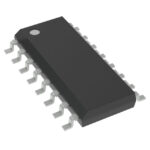 ULN2001D1013TR
The activity of extra discounts on wholesale prices is in full swing…
Please fill in your contact information and we will send you the latest wholesale price list.




