 ChipApex | Global Electronic Components Supplier
SEARCH
Search Product
Search Post
— IC芯片 | 连接器 | 传感器 | 被动器件 —
Search productSearch post
— IC芯片 | 连接器 | 传感器 | 被动器件 —
Consult the customer manager about the wholesale price.
consultation hotline:86-132-6715-2157
email:[email protected]
Contact the product manager for consultation. One-stop consultation is available.
Do you want a lower wholesale price? Please send us your inquiry and we will reply immediately.
The ULN2003AN is a high-voltage, high-current Darlington transistor array manufactured by Texas Instruments. It integrates seven NPN Darlington pairs within a single 16-pin PDIP package. Each channel provides a maximum continuous collector current of 500 mA and can withstand peak currents up to 600 mA. The device features a maximum collector-emitter voltage (Vceo) of 50 V and a maximum collector-emitter saturation voltage (VceSAT) of 1.1 V. Integrated suppression diodes are connected to the common emitter pin to handle inductive load back-EMF. The component operates within a temperature range of -20°C to 70°C.
Verify the manufacturer marking and date code on the physical component to confirm authenticity. Ensure the ordering suffix matches the required package type, as variations exist between through-hole and surface-mount versions. Cross-reference the part number with official Texas Instruments documentation to confirm electrical specifications before integration into production designs.
Select this component when designing circuits that require driving multiple inductive or high-current loads from standard TTL or CMOS logic outputs. The 500 mA per channel rating suits most medium-power applications. Consider alternative packages such as SO-16 if space constraints prohibit the use of the 16-pin DIP form factor.
This component belongs to the ULN2000 series of high-voltage Darlington arrays produced by Texas Instruments. The series includes variants like the ULN2001, ULN2002, and ULN2004, which differ primarily in internal resistor configurations to interface with specific logic families such as PMOS or DTL. The ULN2003AN specifically targets 5 V TTL and CMOS compatibility.
Compatible substitutes include the ULN2003A from other manufacturers, provided the pinout and electrical ratings match. Surface-mount equivalents such as the ULN2003D1 offer identical functionality in an SO-16 package. Verify that any replacement maintains the 500 mA current rating and integrated flyback diode configuration.
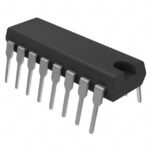 ULN2003AN
The activity of extra discounts on wholesale prices is in full swing…
Please fill in your contact information and we will send you the latest wholesale price list.






