 ChipApex | Global Electronic Components Supplier
SEARCH
Search Product
Search Post
— IC芯片 | 连接器 | 传感器 | 被动器件 —
Search productSearch post
— IC芯片 | 连接器 | 传感器 | 被动器件 —
Consult the customer manager about the wholesale price.
consultation hotline:86-132-6715-2157
email:[email protected]
Contact the product manager for consultation. One-stop consultation is available.
Do you want a lower wholesale price? Please send us your inquiry and we will reply immediately.
The ULN2802A is an octal Darlington transistor array manufactured by STMicroelectronics. It integrates eight NPN Darlington pairs with common emitters and includes integral suppression diodes for driving inductive loads. The device features a 10.5 kΩ input resistor and a Zener diode, specifically designed for interfacing with 14-25 V PMOS logic families. Key electrical parameters include a maximum collector-emitter voltage (VCEO) of 50 V and a continuous DC collector current of 500 mA per channel. Outputs can be paralleled to increase current capability. The component is housed in an 18-lead plastic DIP package suitable for through-hole mounting and operates within a temperature range of -20°C to +85°C.
Verify the manufacturer part number against official STMicroelectronics documentation to ensure authenticity. Confirm that the specific revision matches the required 10.5 kΩ input resistor and Zener diode configuration for PMOS compatibility. Check RoHS compliance status via the manufacturer's official channels. Ensure the package type corresponds to the required 18-lead PDIP form factor for your design.
Select the ULN2802A when interfacing with 14-25 V PMOS logic families due to its specific 10.5 kΩ input resistor and Zener diode. Choose this variant over other ULN280x series members if the application requires this specific voltage range and logic interface. Consider paralleling outputs if the load current exceeds the 500 mA continuous rating per channel. Ensure the operating environment stays within the specified -20°C to +85°C temperature range.
The ULN2802A belongs to the ULN280x family of octal Darlington arrays from STMicroelectronics. This family includes four variants: ULN2801A (general purpose with current limit resistor), ULN2802A (14-25 V PMOS compatible), ULN2803A (5 V TTL/CMOS compatible), and ULN2804A (6-15 V CMOS compatible). All share the same 18-lead PDIP package and internal Darlington structure but differ in input resistance and protection components to suit different logic families.
Publicly confirmed substitute part numbers are not available in the provided source material.
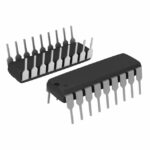 ULN2802A
The activity of extra discounts on wholesale prices is in full swing…
Please fill in your contact information and we will send you the latest wholesale price list.





